
Fees, offers and urgency are where education advertising most often goes wrong, because they are meant to push a parent to act quickly. This guide lists the phrases that carry the most risk, such as 100% placement, last seats and guaranteed admission, and explains the rule behind each. It offers safer rewrites, compliance flags, a Telugu variant and a note on printing size.
Why urgency and offers draw scrutiny
Urgency and offers aim to make a parent decide before they compare. That is the part regulators watch most closely. A claim that pressures a decision needs to be true.
We read two texts in full for this guide. The ASCI guidelines for educational institutions are dated 9 March 2023. The guideline for prevention of misleading advertisements in the coaching sector was notified on 13 November 2024.
ASCI discourages fear of missing out and false urgency. It also discourages the phrase 100% on abstract matters, with 100% placement assistance as an example. It asks that promised ranks, marks and jobs be substantiated and carry a past-record disclaimer.
The coaching guideline prohibits false urgency or scarcity. It also prohibits false claims about fees and refund policy, and it prohibits guaranteeing selection, a job or admission. It applies to centres with more than fifty students.
Reported news items add context. The Ministry of Education's 2024 coaching guidelines were reported, with one source describing them as advisory to states. A consumer regulator was reported to have fined coaching institutes for misleading ads, though AdChowk did not research amounts.
AdChowk's research did not cover rules on early-bird discounts or scholarship wording specifically. Where a rule is silent, the principle is still accuracy and the ability to substantiate. If you cannot prove an offer, do not print it.
Today is November 2026, so most 2027 boards are not yet printed. There is time to review offers and urgency lines without a deadline. Use it before the February to July 2027 window, which is a planning judgment and not an announced date.
A table of risky phrases and safer rewrites
The table lists phrases we see often and what to do with them. Placeholders in square brackets are for facts you control. Rule references are to texts we read in full.
| Risky phrase | Safer rewrite | Why | |---|---|---| | 100% placement | Placement support for the [year] batch; [number] placed of [total] | ASCI discourages 100% on abstract matters and wants the latest completed year and the denominator | | Guaranteed admission | Counselling support for [exam] admissions | Guaranteeing admission or selection is prohibited for coaching | | Last 10 seats | Admissions open until [date] | False urgency or scarcity is prohibited or discouraged | | Only today | Open day on [date] | Urgency must be real | | Best fee in town | Fee structure available at the campus office | A comparative claim needs support (planning judgment) | | Free admission for all | Scholarship for [criteria], terms at the campus office | Fee and offer claims must be accurate | | No donation | Fee details are listed at [place] | Fee claims must be accurate and supportable | | Join and get a top rank | Coaching for [exam], batches from [date] | Implying enrolment ensures a rank is prohibited |
Compliance flags by segment
Schools should be careful with fee and admission-timing lines. Hyderabad officials were reported as saying that admissions should wait for results and that January admissions are illegal. Treat that as reported, and ask your district office what applies.
Schools should also be careful with phrases about limited seats. If seats are truly limited, state the number and the date it was counted. Otherwise leave the line out.
Colleges must name the approving authority where a degree legally needs one, per ASCI. AICTE and UGC notices on approval claims were reported, so check their sites. A phrase such as recognised everywhere is risky without evidence.
Junior colleges face reported extra rules. Telangana's intermediate board was reported to require approval of advertising content and to bar intermediate ads before the admission schedule is announced. Andhra Pradesh was reported to ban publicising marks and ranks, so avoid them on boards there.
Coaching centres with more than fifty students fall under the 2024 guideline. They must not guarantee selection, a job or admission, or imply that joining ensures a rank. They must not use false urgency or false fee and refund claims.
For placement-led programmes, ASCI wants the latest completed year and the total passing-out class. It also wants the ranking publisher and date for ranking claims. A single large placement number without a denominator is a common flag.
For all segments, offers must be true on the day the board goes up. Remove a board when an offer ends. Ask the media owner how long a board stays up so that the offer does not outlive its terms.
Telugu variants, size and reading distance
Risky phrases are risky in every language. Do not assume that a Telugu version escapes scrutiny. Rewrite the idea, not only the words.
Safer Telugu lines can invite rather than pressure. ప్రవేశాలు [తేదీ] వరకు means admissions until [date]. ఓపెన్ డే: [తేదీ] means open day on a date you will honour.
ఫీజు వివరాలు క్యాంపస్ ఆఫీసులో means fee details at the campus office. గత ఫలితాలు భవిష్యత్తుకు హామీ కాదు means past results are no assurance of the future. Have a native reader check each line.
Where a past-record disclaimer applies, keep it in the same size as the claim. Both texts we read in full ask for that. That limits how many claims a board can carry.
AdChowk's research did not cover a standard table of letter heights against reading distance. Ask the media owner for the board's dimensions and typical viewing distance. Test a small print from across a room.
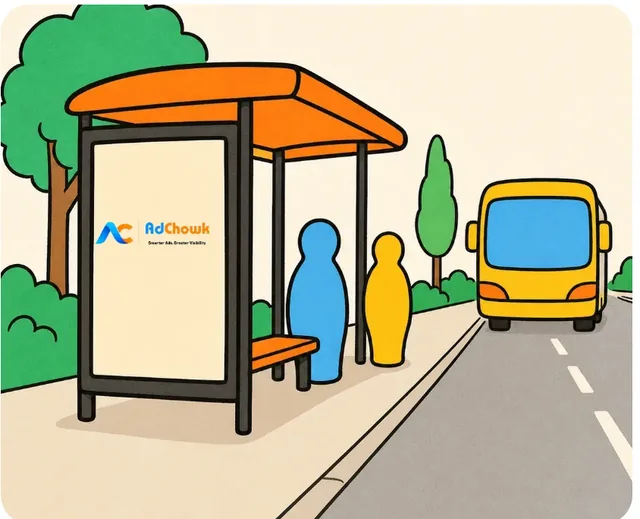
As a planning judgment, an offer line is better on a pole board or bus shelter, where readers have a little more time. A hoarding at a junction should carry the name and one fact. Put detailed fee terms behind a QR code, with the same disclosures there.
Avoid exclamation marks and capital-letter shouting. They add pressure and take space. A calm board is often a more credible board.
Timing, formats, a sample plan and how AdChowk works
Planning judgment puts the heavy windows between February and July 2027. Almost every 2027 date is unannounced, so confirm yours. Set deadlines that you can honour, and do not guess them.
Pole boards and bus shelters suit a short offer line with a clear end date. Hoardings at junctions suit a name and the news that admissions are open. Lift screens suit slightly longer text, because people stand still.