
Trending Now :
37 ad categories. 423 formats. Know more
Hyderabad live — 2,281 sites mapped, 1,810 bookable today. Know more
Every placement photographed on site. Know more

Search for something...
37 ad categories. 423 formats.Browse Now
Hyderabad live — 2,281 sites mapped, 1,810 bookable today.Browse Now
Every placement photographed on site.Browse Now

Booking Outdoor: In-House, Agency or Marketplace?

A neutral comparison of booking outdoor advertising in-house, through an agency or through a marketplace, with a table, vendor questions and a list of eight jobs.

Updated

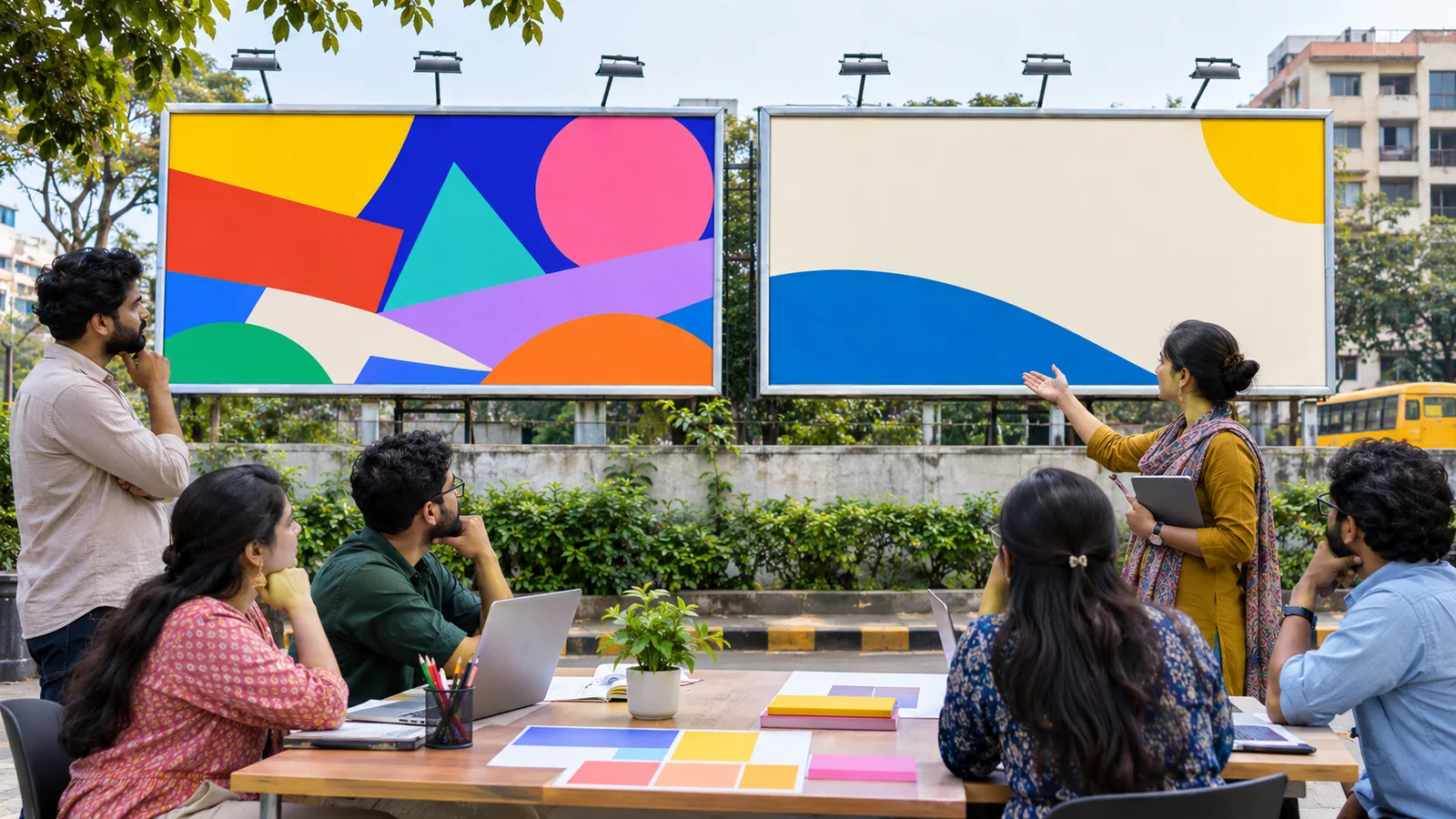
Build a readable hierarchy and an accessible response path editorial illustrationPlan smarter.
Be seen better.

There are three ways to book outdoor advertising: in-house, through an agency or through a marketplace. This guide compares them neutrally, with a table, eight jobs to assign and questions to ask each route. AdChowk is a marketplace, so we state our interest openly.

Three routes, eight jobs and our interest

An institute that wants outdoor advertising has three ways to book it. It can do it in-house, go through an agency or use a marketplace. This guide compares them in neutral terms and says when each tends to fit.

We must state our interest first. AdChowk is an outdoor advertising marketplace operated by Shivix Adsphere Pvt Ltd. We are not an agency and we do not manage your brand.

AdChowkA little room to read

Three routes, eight jobs and our interest

Continue the story. Keep your place.

That means we sit in one of the three columns. We have tried to keep the comparison fair anyway. Every statement is a planning judgment unless a source is named.

In-house means the institute contacts media owners and printers directly. An agency means a firm that plans, buys and manages the campaign for a fee or a margin. A marketplace means a platform where media owners list inventory and buyers choose or are guided to it.

These are working definitions, not legal categories. Real vendors blend them. Ask each one how it works and who is paid for what.

Each route has a job it does well. In-house gives control and direct relationships. An agency gives planning and handling of the details.

A marketplace gives a view of many options in one place. It can also guide a buyer from a budget and a goal to a plan. It does not remove the need to check permissions and proofs.

None of the three can promise admissions. None can promise enquiries in a given number. Any vendor that says otherwise should be asked for evidence.

The honest role of outdoor advertising is to make people in a locality notice and remember an institute. Whichever route you choose, that is what the boards can do. They cannot enrol a child.

The real question is who takes which job. Planning, site choice, permissions, creative, printing, installation, proof and tracking are eight jobs. Decide who does each before you book.

Write the eight jobs on a page. Put a name next to each: institute, vendor or both. The blank spaces are your risks.

An institute with a strong admission head and time may take many jobs in-house. An institute with little time may hand more to a vendor. Neither is better in itself.

A common mistake is to assume a vendor does a job it does not. Permissions and proof are the usual gaps. Ask directly.

Another mistake is to assume a low-priced route is a light one. Effort and cost are different things. AdChowk carries no prices here and will not suggest any.

Read this guide with the cost guide. Link: education advertising cost in India. It explains how to ask for quotes without made-up numbers.

Schools can read the main planning guide. Link: school admission outdoor advertising guide. Coaching centres and colleges have their own.

Links: coaching centres and college admission campaigns. The comparison applies to all three. The rules on claims differ by segment.

Start from your own capacity. How many hours a week can someone give? That number decides how many jobs you keep.

Start also from the calendar. Sites near good locations tend to be secured early, as a planning judgment. Permissions take time.

The sections that follow cover the table, when each fits, what may be printed and a plan. Each is short and plain. Skip to the one you need.

Good ideas. Clear thinking.

A neutral comparison table and what to ask each route

Here is a neutral comparison of the three. Every entry is a planning judgment, not a measured fact.

| Question | In-house | Agency | Marketplace | |---|---|---|---| | Who plans | The institute | The agency | The buyer, guided by the platform | | Who deals with media owners | The institute | The agency | The platform connects buyer and owner | | Control | High | Medium | Medium to high | | Time needed from the institute | High | Lower | Medium | | Choice visible | Limited to who you find | Limited to who the agency uses | Many listed options | | Proof and tracking | Yours to arrange | Ask the agency | Ask the platform |

AdChowkA little room to read

A neutral comparison table and what to ask each route

Continue the story. Keep your place.

The table has no prices because AdChowk has no basis for them here. It has no performance figures because none were measured. Treat it as a map of jobs, not a ranking.

In-house wins on control and direct relationships. It loses on time and on knowing which sites work. A small institute with a motivated admission head can do it.

An agency wins on handling the details. It loses on the institute's visibility into choices and margins. Ask how the agency is paid.

A marketplace wins on the view of many options. It loses if the listings are unverified or out of date. Ask how listings are checked.

AdChowk's own catalogue is large but its listings are not all verified. We therefore say thousands of ad spots across Hyderabad in general terms and give no counts. We ask you to check any specific site.

Formats within outdoor do different jobs whichever route you take. A pole board builds familiarity where people wait or walk. A hoarding builds name recall across a wider catchment.

A no-parking board is a branded board on a gate or wall near homes. It needs the property owner's permission. An auto or tricycle carries the name through streets.

A bus shelter or lift screen reaches people with time to read. Each deserves its own code. See the guide: WhatsApp keyword per board.

Ask each route the same questions. Who does the planning and how is it explained? Who checks permissions, and can you see them?

Ask who owns the creative files and the tracking numbers. The institute should own both. They stay useful after the campaign.

Ask what proof is given. AdChowk aims to return a GPS-stamped photograph of every placement. Ask any route how proof is given.

Ask what is not claimed. The honest answer includes reach, impressions and return. Write the answers down.

Ask how problems are handled. If a board is removed or damaged, who tells you and who fixes it? How fast?

Ask how payment is arranged. AdChowk's research did not cover payment terms for any route, so ask each in writing. Keep the answers on file.

Ask about contracts. What happens if you cancel? What happens if the site is lost?

Ask about language. Telugu and English boards may need separate placements. Plan both from the start.

Ask who checks the creative against the rules. The institute remains responsible for its claims. A second read before print is cheap.

Keep the comparison on one page for the trustees. Add your own notes. It is a good start for discussion.

Use the funnel guide to read results. Link: enquiry-to-admission funnel. It explains the limits of attribution.

Seasonality affects every route. Enquiries rise when results are out and when schools reopen. Do not credit a route for a season.

Good ideas. Clear thinking.

When each tends to fit and habits that help

When does in-house tend to fit? When the institute has time and a person who likes the work. When the plan is small and local.

When does an agency tend to fit? When the institute wants to hand off most jobs. When the plan spans media and the institute wants one point of contact.

AdChowkA little room to read

When each tends to fit and habits that help

Continue the story. Keep your place.

When does a marketplace tend to fit? When the institute wants to see options and ask for a plan from a budget and a goal. When it is happy to keep some jobs, such as creative approval.

A small institute with a tight catchment often starts in-house or with a marketplace. A larger one with several branches may use an agency. These are planning judgments, not measured results.

A coaching centre with batch dates may prefer a route that handles speed. It must keep any results claims within the coaching rules. Collect written consent before any topper image.

A junior college must be careful about timing and claims. Telangana's board is reported to bar intermediate advertisements until it announces its schedule. In 2026 that schedule came in early May and was revised.

A degree or engineering college often plans for April to July. That follows the 2026 pattern of DOST, EAPCET and OAMDC. Counselling-specific claims should wait for official dates.

A school may plan boards from February 2027 as a planning judgment. Hyderabad officials were reported in January 2026 as saying admissions should wait until results in April or May. Check the district education officer's position first.

Do not choose a route on price alone. A low quote that leaves permissions to you is not low in effort. Compare what each includes.

Do not choose a route on a promise of results. None can be backed. Ask for the method behind any number.

Do not skip the permission question. No-parking boards need the owner's consent. Larger formats need civic permissions that AdChowk's research did not cover in full.

Do not skip proof. A list of placements without photographs is a promise. Ask for the photographs.

A mixed route is fine. Some institutes book a hoarding through an agency and no-parking boards through a marketplace. Keep one tracking scheme across all.

Keep one folder for the campaign. Put the plan, the creative, the permissions and the proofs in it. Next year will be easier.

Use one WhatsApp number across routes. Different keywords tell you the family. The institute owns the number.

Run a small test. Book one family through one route and track enquiries. Use the result to decide the next route.

Review after each season. Which route gave the clearest plan and the best proof? Which left gaps?

Retire old codes. Start fresh each cycle. Old codes blur the register.

Keep a map with pins. It helps trustees see the plan. It also helps next year's planner.

If in doubt, ask for a conversation. AdChowk will talk through the options and be honest about what it does not cover. We cannot advise on digital advertising.

This is general information. Check the current notice from the relevant authority before printing. Rules change.

Good ideas. Clear thinking.

What may and may not be printed

The advertising rules apply to whatever you print, whichever format you choose. ASCI's Guidelines for Educational Institutions (9 March 2023) were read in full for this research. They bar implied recognition or accreditation without substantiation.

If an affiliating institution is named, its name should appear at no less than half the font size of the institute's name. Ranking claims must name the publisher and the date. Statistics must relate to the latest completed year.

AdChowkA little room to read

What may and may not be printed

Continue the story. Keep your place.

Infrastructure images must be real. Promised ranks, marks or jobs need substantiation and a past-record disclaimer. The word 100 percent should be avoided on abstract matters.

Topper testimonials may come only from students who completed the programme. False urgency and fear of missing out are discouraged. The simplest safe route is to leave such claims off a board.

For coaching, the Guidelines for Prevention of Misleading Advertisements in the Coaching Sector 2024 were also read in full. They were notified on 13 November 2024 under the Consumer Protection Act 2019. They apply to centres with more than 50 students.

They prohibit false claims about courses, faculty, fees, refunds, selections and ranks. They bar any promise of selection, a job or admission. They also prohibit false urgency.

Topper advertisements must show the rank, the course name, its duration and whether the course was paid for. Disclaimers must be in the same font as the claim. Written consent is taken after selection.

Some rules are reported only, and AdChowk has not read the originals. They include CBSE advisories on affiliation wording and Telangana board approval of junior college advertisements. They also include an Andhra Pradesh ban on publicising intermediate marks and ranks, and AICTE and UGC approval notices.

Hyderabad's CURE-2026 policy is reported to restrict advertisements near schools and hospitals. That is a reason to plan boards on parent routes and in colonies rather than at the gate. Verify the notified text before relying on this.

What may be printed? The institute's name, a plain description, a contact route and a code or keyword. Any claim must be one you can substantiate.

What may not be printed? Promised results, invented numbers, false urgency or implied approvals. Do not print any rule or approval you have not checked.

No-parking boards are branded boards fixed on gates and walls. They need the property owner's permission, kept on file. AdChowk does not describe any board as legal or approved.

Keep a signed-off copy of every creative with its date. Have a bilingual reader check Telugu and English text. None of this is legal advice, and rules change, so check the current notice before printing.

Good ideas. Clear thinking.

Timing, an illustrative plan and how AdChowk works

Timing: today is November 2026, and the 2027-28 season is in its build phase. Heavy outdoor windows are planning judgments, not announced dates. School outdoor is likely to peak from February 2027.

Coaching and degree outdoor is likely to run from March to July 2027. None of the 2027 dates is announced. Junior colleges should wait for the board's schedule.

AdChowkA little room to read

Timing, an illustrative plan and how AdChowk works

Continue the story. Keep your place.

Here is an illustrative plan, with no prices or results. It is a shape, not a recommendation. A day school with limited time chooses a marketplace route for planning and keeps creative approval.

In December it writes down the eight jobs and who does each. In January it asks for a plan, permissions and a tracking scheme. In February boards go up with photographs and a weekly report.

How AdChowk works. AdChowk is an outdoor advertising marketplace operated by Shivix Adsphere Pvt Ltd. You state a budget and an admission goal, and we plan a mix of formats and localities.

We show you the reasoning behind the plan. Media owners list on the marketplace and keep their own rates. We are not an agency and we do not promise results.

AdChowk aims to return a GPS-stamped photograph of every placement. That photograph is the proof that a board is where the plan said it would be. Ask us how it works for your boards.

We agree codes, numbers or keywords with you before printing. The institute keeps ownership of its numbers. We share a weekly report layout.

We cover outdoor formats only. We do not give advice on Google or Meta advertising. If you want digital, ask another adviser.

Our creative read is a check against the rules above, not a legal clearance. It catches common errors early. The institute remains responsible for its claims.

To plan outdoor formats and areas for your goal, open the calculator. Link: area calculator. For the wider education offer, see education advertising.

Next step: open the area calculator and see how a plan could look for your institute. Then send us a WhatsApp message with your institute type, area and dates. We will reply with questions before any plan.

Whichever route you choose, write down who does what. The gaps on the page are your risks. Fill them first.

Good ideas. Clear thinking.
Build a readable hierarchy and an accessible response path editorial illustration
Ready to plan?

Turn the guide into a real media shortlist

Browse verified inventory by location and format, or ask our team to help build your campaign plan.

Cookie Icon
Booking Outdoor: In-House, Agency or Marketplace? | AdChowk