Trending Now :
37 ad categories. 423 formats. Know more
Hyderabad live — 2,281 sites mapped, 1,810 bookable today. Know more
Every placement photographed on site. Know more

Search for something...
37 ad categories. 423 formats.Browse Now
Hyderabad live — 2,281 sites mapped, 1,810 bookable today.Browse Now
Every placement photographed on site.Browse Now

Apartment and Colony Branding for Schools and Tuition Classes

Apartment and colony branding reaches parents where they live. See how lift screens and gate boards work, how quotes and proof read, and the consent limits.

Updated

Digital advertising screen inside an apartment liftPlan smarter.
Be seen better.

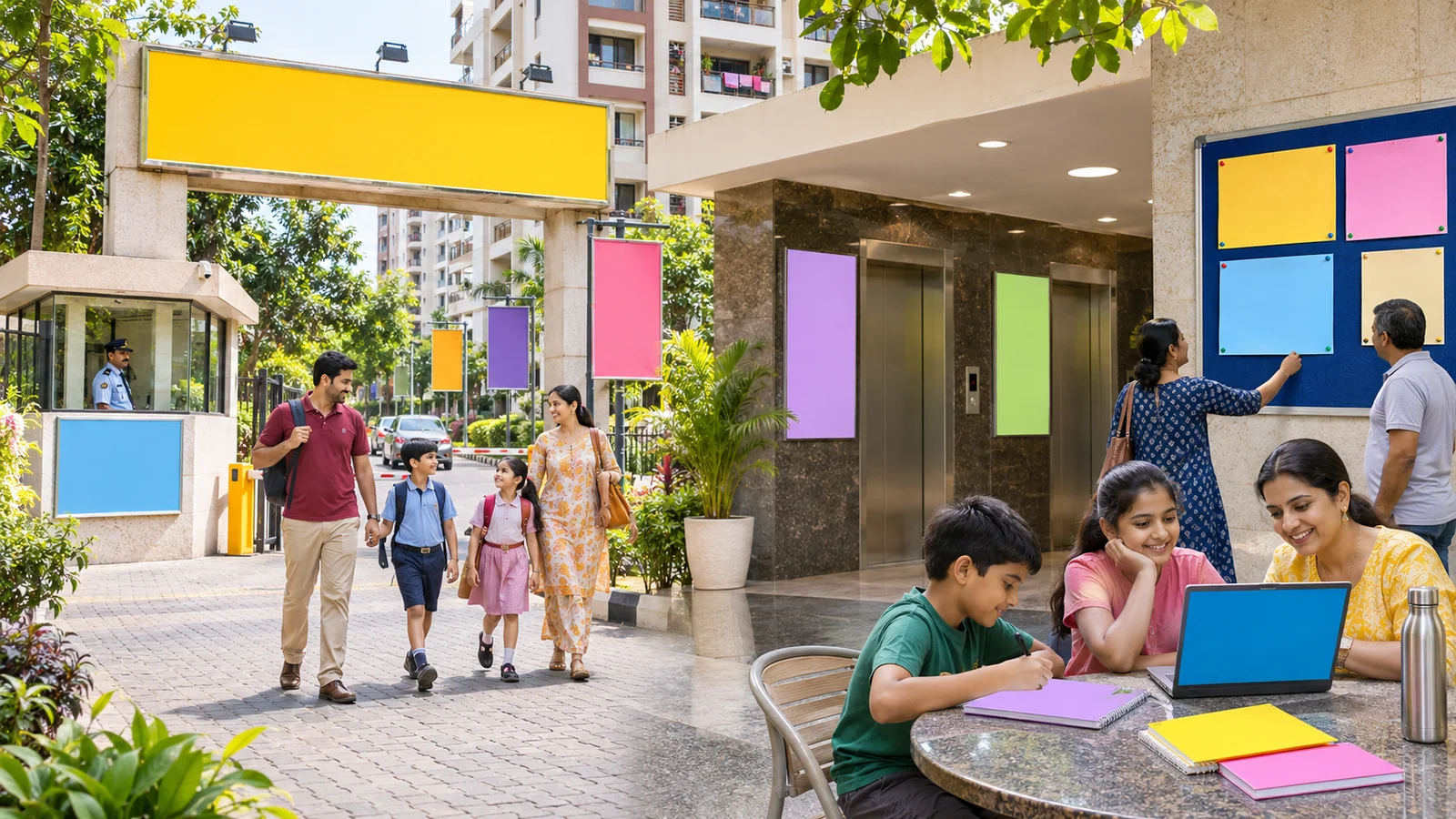
Apartments and colonies are where families live, so branding there reaches parents on their own ground rather than on a busy road. It fits a school or tuition class whose catchment is a handful of communities. This guide covers what the format is, who sees it, how quotes and proof work, a sample brief and the limits, including the need for consent.

What apartment and colony branding is, who sees it and when it works

Apartment and colony branding means placing your institute's name inside or at the entrance of a residential community. AdChowk's catalogue lists apartment lift screens and branded boards on apartment and colony gates among its formats. Other placements in this family can include notice-style displays and gate boards, each of which needs the community's agreement.

The people who see it are residents, visitors and domestic staff, and among them the parents of the children you want to enrol. A lift screen is seen from a few feet away, for the time the lift takes, so the message is short and the audience is captive for a moment.

AdChowkA little room to read

What apartment and colony branding is, who sees it and when it works

Continue the story. Keep your place.

A gate board is seen on every entry and exit, which makes it a daily sighting for the same households. That repetition suits a school, play school or tuition class, where families choose a name they already know.

It also suits the parents' route question, because the apartments and colonies on a family's route are where the day begins and ends. Hyderabad's CURE-2026 policy is reported to restrict advertisements near schools and hospitals, so education plans go to colonies, lifts and routes parents use.

That is a reason this format works for education, because it sits away from the school gate. The audience is limited to the communities you choose, and the format does not help you reach families elsewhere.

It is also a format that depends on a third party, because the association or owner must agree. A community may say no to commercial displays, or may allow only certain forms, and the plan has to accept that answer.

A well-chosen community is one where your enrolled families live, where nearby families have children of the right age, and where the association is open to it. The key limit is that this format builds recognition among those residents and does not reach the wider city.

Outdoor advertising builds familiarity; it does not close an admission on its own. A family that sees the same name on a route it travels every day is more likely to recognise it when the enquiry moment comes, which is a planning judgment and not a measured result.

AdChowk has no measured reach, response or admission figures for education campaigns, and this guide does not offer any. The honest job of apartment and colony branding is to support a decision the family is already making and to give the follow-up channel a visible address.

Pair every placement with one simple next step such as a phone number, a QR code or a WhatsApp keyword. Without a tracking step, nobody can tell which placement prompted an enquiry.

Good ideas. Clear thinking.

Pricing unit, minimum order and GPS photo proof

For apartment and colony formats, the pricing unit varies by placement, and AdChowk's research did not settle one unit. A lift screen may be priced per screen or per community for a period, while a gate board may be priced per board. Ask what the unit is, how long the period is, and whether printing, installation and removal are included.

Minimum order depends on the owner of the screens or the installer, and some sell by community or by cluster of communities. AdChowk's research did not verify a minimum order that holds across owners, so ask in writing.

AdChowkA little room to read

Pricing unit, minimum order and GPS photo proof

Continue the story. Keep your place.

A tuition class that wants only two communities should ask whether the owner will sell exactly two or whether a larger cluster is the smallest unit. Proof is a photograph of each placement in its place: the screen in the lift, the board on the gate.

AdChowk aims to return a GPS-stamped photograph of every placement, so that the community and the position are on record. A useful photograph shows the placement and a landmark, such as the community name board, so that the location is clear.

For a screen, ask what proof the owner gives that your creative was shown, and when. Raise any difference between the plan and what you see with your planner the same day.

Keep the community's consent with the photograph, so that the two travel together. Do not compare a lift-screen quote with a gate-board quote without converting them to the same period and the same number of communities.

If the owner offers a bundle across many communities, ask which communities, since a bundle is only as useful as its list. AdChowk does not publish prices in this guide, because rates depend on the site, the period and the media owner.

Ask for the pricing unit in writing before comparing quotes, because a per-piece, a per-month and a per-campaign quote cannot be compared directly. Minimum order depends on the media owner and the format, and AdChowk's research did not give a verified figure that applies to every site.

A fair quote states the unit, the period, the quantity, whether printing and mounting are included, and the removal date. AdChowk aims to return a GPS-stamped photograph of every placement, so that you can see where the creative actually went.

A good proof photograph shows the creative, the surroundings and the location stamp together, taken after installation. Check the photographs against the plan on the day they arrive and raise any mismatch with your planner at once.

Good ideas. Clear thinking.

Timing, consent and what may be printed

Placements inside a community need the consent of the association or the property owner before anything is installed. AdChowk's research did not cover the rules for residential-community advertising in each city, so ask the owner what permission is in place. AdChowk does not describe any placement as legal or approved; the permission question belongs to the owner, the association and the local authority.

Print the name, a short descriptor and one contact step; add an affiliation line only if you can prove it. If you name an affiliating board, show that name at no less than half the font size of the school's name.

AdChowkA little room to read

Timing, consent and what may be printed

Continue the story. Keep your place.

Do not publish a ranking, a pass percentage or a topper photograph without the publisher, the date, the latest completed year and the consent that the guidelines require. For timing, schools can run a trust-and-name wave in communities from now and keep the main wave for February to April 2027, subject to the DEO position.

Today is November 2026, so this is the build phase for the 2027-28 admission year and not the peak. The heavy outdoor windows fall between February and July 2027, which is a planning judgment and not an announced date.

Almost every 2027 admission date is still unannounced, so plan for a window rather than a date and check the official page before printing any date. Reported: Hyderabad officials said school admissions should wait for results in April or May, so each school should confirm its position with the District Education Officer.

Reported: Telangana's intermediate board has asked private junior colleges to get advertisement content approved before use and not to advertise before it announces the admission schedule. Reported: Andhra Pradesh has banned publicising intermediate marks and ranks, so college creative there carries no marks or ranks.

Read in full: the ASCI Guidelines for Educational Institutions (9 March 2023) say affiliation or recognition must not be implied without substantiation, and an affiliating body's name must appear at no less than half the font size of the institute's name. Read in full: those guidelines require statistics for the latest completed year, ranking claims that name the publisher and date, and real images of infrastructure.

Read in full: they also bar promised ranks, marks or jobs without substantiation and a past-record disclaimer, and they discourage "one hundred percent" claims on abstract matters and false urgency. Read in full: the Guidelines for Prevention of Misleading Advertisements in the Coaching Sector 2024 (notified 13 November 2024) prohibit guaranteeing selection, a job or admission, and prohibit false urgency.

Read in full: under those guidelines a topper advertisement shows the rank, the course name and duration, and whether the student paid, with written consent taken after selection and disclaimers in the same font as the claim. Those coaching guidelines apply to centres with more than 50 students, and smaller centres do well to follow the same discipline.

Reported: Hyderabad's CURE-2026 policy restricts advertisements near schools and hospitals, so plans lean on colonies, lifts, bus shelters and routes parents use. Reported: GHMC removed unauthorised hoardings, banners and flex in a drive in January 2026, and Andhra Pradesh reportedly issued Display Devices Rules in December 2025; verify both against the notified texts.

Good ideas. Clear thinking.

An illustrative plan and a sample brief

Here is an illustrative plan for a day school and a tuition class sharing a catchment of five communities; it is a structure and not a quote. Step one is to list the communities where your current families live and those within a short ride of the campus. Step two is to ask each association for consent, in writing, and to note what forms of display it allows.

Step three is to choose one lift-screen community and several gate-board communities for the first wave, according to what is allowed. Step four is to approve a short creative: name, one line, one contact step.

AdChowkA little room to read

An illustrative plan and a sample brief

Continue the story. Keep your place.

Step five is to read the proof photographs and compare them with the consent letters. Step six is to log the enquiries by community, if the enquirer volunteers it.

A sample brief might read: institute type, day school; area, five communities near the campus; goal, name recall among parents of children aged two to six; formats, lift screens and gate boards; start, February 2027; contact step, one WhatsApp keyword. A tuition class would write the brief around the communities its students come from and a subject or grade line, with no claims about marks.

Add to the brief who obtains consent, how it is recorded, and the date by which it is needed. Do not ask a community to carry anything that the school cannot support with proof.

Use the area calculator to describe the catchment and treat the community count as an estimate to test on the ground. Pair the community presence with one road format on the parents' route, so that people see the name inside and outside their homes.

Keep the same creative for the first cycle so that you compare communities and not designs. Avoid any wording that suggests seats are about to run out unless it is true and documented.

At the end of the cycle, compare enquiries by community with the proof before repeating. Drop communities that stayed silent and keep those that produced calls.

The plan below is illustrative; it contains no prices, no results and no real institute. Final quantities, sites and dates follow a site check and written permissions.

Review the proof photographs at the end and decide what to repeat, move or drop in the next cycle. Keep one short log of enquiries by source so that the next plan rests on your own records.

Good ideas. Clear thinking.

How AdChowk works with apartment and colony formats

AdChowk lists apartment lift screens and gate boards among its formats, and a planner can propose communities against your goal and budget band. You tell AdChowk your institute type, city and area, courses, seats and intake start date, and the planner proposes communities and the reasoning behind each. Placements come through media owners listed on AdChowk, who keep their own rates, and AdChowk aims to return a GPS-stamped photograph of each one.

AdChowk asks owners about permissions and about the association's consent, and does not present any placement as approved by an authority. Because consent is a human conversation, a planner can tell you early which communities are likely to take time.

AdChowkA little room to read

How AdChowk works with apartment and colony formats

Continue the story. Keep your place.

If you want to get a quote for this format, use the short form or send a WhatsApp message and ask for one. Start with the education advertising overview if you are comparing formats, and use the area calculator for your catchment.

For the cost side, see the guide on how education advertising costs are worked out. A school can read the school admission outdoor advertising guide for the full timeline.

A coaching centre can read the guide to outdoor advertising for coaching centres. Bring your list of enrolled families' communities to the first conversation, as it shapes the shortlist.

A few communities with consent and proof are a better start than many without. AdChowk is an outdoor advertising marketplace operated by Shivix Adsphere Pvt Ltd.

You state a goal and a budget band, and AdChowk plans the mix of formats and localities and shows you the reasoning. Media owners list on AdChowk and keep their own rates.

AdChowk aims to return a GPS-stamped photograph of every placement. The first step is a short form or a prefilled WhatsApp message, one ask and not two.

The longer quote step asks for institute type, city and area, courses, seats, intake start date, budget band, formats and phone number. If you plan to show ranks, topper photos or approval numbers, AdChowk asks for your evidence at the quote step, because the burden of proof sits with the advertiser.

This guide covers outdoor formats only and gives no advice on Google or Meta advertising. AdChowk does not promise reach, enquiries or admissions; outdoor builds familiarity and the follow-up conversation is yours.

Good ideas. Clear thinking.
Build a readable hierarchy and an accessible response path editorial illustration
Ready to plan?

Turn the guide into a real media shortlist

Browse verified inventory by location and format, or ask our team to help build your campaign plan.

Cookie Icon