
Trending Now :
37 ad categories. 423 formats. Know more
Hyderabad live — 2,281 sites mapped, 1,810 bookable today. Know more
Every placement photographed on site. Know more

Search for something...
37 ad categories. 423 formats.Browse Now
Hyderabad live — 2,281 sites mapped, 1,810 bookable today.Browse Now
Every placement photographed on site.Browse Now

College and Junior College Admission Advertising: Outdoor Plans for Intermediate, Degree and Professional Courses

The main page for colleges: formats, the admission calendar, what colleges and junior colleges may print about approvals, ranks and placements, and how a campaign is planned and proved.

Updated

Build a readable hierarchy and an accessible response path editorial illustrationPlan smarter.
Be seen better.

Colleges and junior colleges advertise to two audiences at once, the student who will study there and the parent who will pay and worry. This is the main page for colleges on AdChowk: it connects the outdoor formats, the admission calendar, the rules on what may be printed and the way a campaign is planned and proved. Where a rule is known only from news reports it is labelled as reported, and none of this page is legal advice.

Who this page is for and what outdoor advertising can honestly do for a college

This page is for the admission head, principal, registrar or marketing head of a degree, engineering or professional college, and for the correspondent or principal of a junior college. It explains which outdoor formats suit college admissions, how the calendar differs from the school year, what a college must be careful about when naming approvals, ranks and placements, and how a campaign can be planned and checked. The page is general planning information and not legal advice.

A college decision is made by a student who is old enough to have opinions and a family that is old enough to ask hard questions. The student compares courses, campuses and reputations on a phone, while the parent asks about approvals, fees, safety and what the degree leads to. Outdoor advertising reaches both in the places where they travel, but it answers only the first question, which is whether the college is a real, visible option worth a closer look.
AdChowkA little room to read

Who this page is for and what outdoor advertising can honestly do for a college

Continue the story. Keep your place.

Colleges depend on counselling and online admission routes such as the common entrance counselling for engineering seats and the state online admission systems for degree courses, so many students arrive through a process rather than through an advertisement. That does not make outdoor advertising pointless, because students still choose which colleges to list and which to visit, and a familiar name is more likely to be chosen.

It does mean that the message should help a student find the college and trust it, and should not pretend to be the admission route itself.

Junior colleges face an additional point, because their advertising in Telangana and Andhra Pradesh is reported to be tightly controlled by the intermediate boards. A junior college that wants outdoor advertising should settle the board’s position before it plans any creative, since a hoarding that has to be withdrawn wastes both money and goodwill. The rules section below explains what is known and what is only reported.

We have not measured how many admissions or enquiries outdoor boards produce for colleges, and no benchmark exists that this page can honestly quote. Treat any claim of guaranteed admissions, guaranteed rank or guaranteed results from a media seller with caution, and ask for the method behind any figure. The reliable judgment is your own enquiry log, course by course, compared with your earlier admission cycle.

AdChowk is an outdoor advertising marketplace where you state a budget and an admission goal, and the platform plans a mix of formats and localities and shows the reasoning behind that mix. It plans outdoor formats only, so a college that also uses digital channels, counsellors or school visits should keep one person responsible for the combined message. The rest of this page shows how that planning works for a college.

Read in order if outdoor advertising is new to your college, or jump to the rules section if a board or regulator has asked about your advertising. The sample campaign structures are illustrative and contain no prices or results, because none have been fixed or measured. The questions at the end collect the points college leaders raise most often.

Good ideas. Clear thinking.
Build a readable hierarchy and an accessible response path editorial illustration

The outdoor formats a college can use and the job each one does

College admission advertising is usually about being seen where students and parents already move, such as bus stops, approach roads and the areas around other institutions. AdChowk lists several outdoor formats that fit this, and the useful way to read the list is by the job each format does. A plan that assigns a clear job to each format is easier to explain to a management committee than one that simply buys visibility.

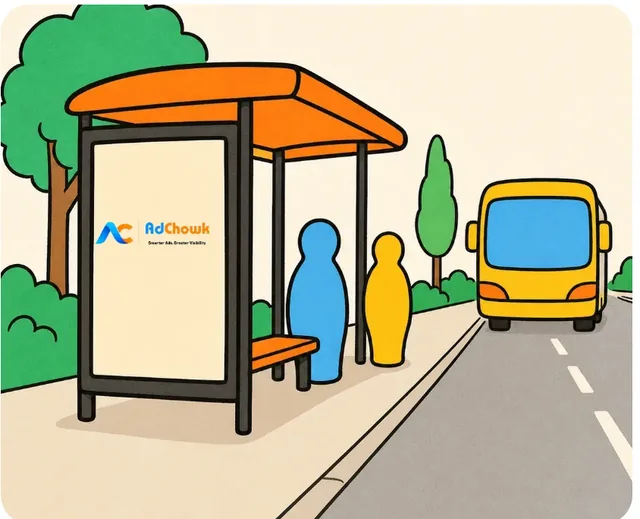
Bus shelters suit colleges because students and parents wait at them, which gives a little more reading time than a passing vehicle allows. A shelter on the route between a student’s home area and the campus can carry the college name, the course families and a way to respond. Choose shelters on routes that students actually use, because a shelter on an unused road adds no value.
AdChowkA little room to read

The outdoor formats a college can use and the job each one does

Continue the story. Keep your place.

Hoardings on the approach roads to the campus work as a wayfinding and reputation signal, telling passers-by that the college is established and where it is. They suit colleges whose campus is hard to find or has recently moved. Because a hoarding gives a large copy area, keep it to the name, the course families, one provable strength and a response route.

Auto-tops and similar local transit branding move through the neighbourhoods around junior colleges and coaching hubs, where students gather. Their strength is coverage across an area rather than certainty about who sees them, so they are best read as a way to be seen widely. Ask the partner how routes are chosen and how you will know where the vehicles actually ran.

Pole boards and no-parking boards near coaching areas and hostels put the college name in front of students who are already thinking about the next step. No-parking boards are branded boards fixed on gates and walls and they need the property owner’s permission. Use them in small clusters so that a student passing the same area every day sees the name repeatedly.

Which of these formats belongs in a plan depends on the college type. A junior college often benefits from formats close to schools and coaching areas, while a degree or engineering college may need approach-road visibility and bus-route coverage. A professional college that recruits from a wide area may use fewer formats in more cities, but each added city needs its own check of local rules.

Ask for the location, the date and a photograph of each placement once it is live, because proof is part of what you are buying. AdChowk aims to return a GPS-stamped photograph of every placement it delivers, so a college can confirm where its message appeared. Where a placement is not permitted, ask the partner to propose an alternative rather than leaving a gap in the plan.

Good ideas. Clear thinking.
Organise delivery evidence and the final review editorial illustration

When a college should advertise: the admission calendar for Telangana and Andhra Pradesh

College admissions do not follow a single calendar, because degree, engineering, professional and intermediate courses each run on their own schedule. Today is November 2026, which is still preparation time for most of them. The heavier outdoor windows for the 2027–28 intake are likely to fall from around April to July for degree and professional courses, which is a planning judgment and not a published rule.

For junior colleges the schedule is led by the board, and reports say Telangana’s intermediate board does not allow admission advertising until it announces the admission schedule. That makes the board’s announcement the real start date for outdoor messages about intermediate admissions. Until then, a junior college can prepare sites, creative and approvals without printing admission wording.

AdChowkA little room to read

When a college should advertise: the admission calendar for Telangana and Andhra Pradesh

Continue the story. Keep your place.

Degree colleges in Telangana and Andhra Pradesh depend on online admission systems and counselling rounds, which set the rhythm of when students decide. A college should look at the announced dates for those systems each year and plan its heaviest outdoor weeks just before and during the choice period. Because those dates change, confirm them from the official notice before fixing a campaign calendar.

Engineering and professional colleges often face an earlier decision moment, when entrance results are announced and students begin to compare seats. A message that reaches students while they are shortlisting is more useful than one that arrives after they have submitted their choices. Plan the first outdoor weeks to land when entrance results are expected, and keep a second wave ready for the counselling period.

In the preparation months, work through approvals, site shortlists, permission, creative and the claims register. Ask for site holds for the likely peak, because good locations near approach roads and bus routes tend to be taken early. Collect written permissions for any student or alumni photographs you plan to use, so they are ready before the season.

Plan production backwards from the first day a message must be visible, and allow a correction round before printing. Ask each partner how long permission, printing and installation normally take, since lead times differ. Share the calendar with every owner, including the person who signs off claims, so a late approval is visible early.

AdChowk does not fix any of these dates, and the periods above are planning prompts to be checked against official notices. If the notice has not been published, plan around evergreen messages about the college’s courses and facilities rather than date-driven ones. Revisit the calendar each cycle, because boards and admission systems change their schedules.

Good ideas. Clear thinking.
Build a readable hierarchy and an accessible response path editorial illustration

What colleges and junior colleges may and may not put on a board

College advertising is regulated from several directions at once, which is why the rules have a section of their own on this page. AdChowk is an intermediary and not the advertiser, but the claims on a board belong to the college. What follows separates what was read in full from what is only reported, and it is general information and not legal advice.

The Advertising Standards Council of India guidelines for educational institutions, programmes and platforms, dated 9 March 2023, cover universities, colleges, schools, coaching classes and edtech. They were read in full for AdChowk’s research, so they are the best-supported part of this section. Check the current text on the council’s website before relying on any detail.

AdChowkA little room to read

What colleges and junior colleges may and may not put on a board

Continue the story. Keep your place.

As summarised in that research, the guidelines ask colleges not to imply recognition, accreditation or affiliation without substantiation. Where a degree legally requires an approving authority, the advertisement should name it. If an affiliating institution is named, its full name and location should appear at no less than half the font size of the advertised name.

Statistics are expected to relate to the latest completed academic year, ranking claims are expected to name the publisher and the date, and placement figures are expected to state the total size of the passing-out class. The guidelines discourage the phrase one hundred percent on abstract matters, with placement assistance given as an example. Testimonials from toppers are expected to come only from students who completed the programme at that institution.

The guidelines also ask for real infrastructure images, warn against promised ranks, marks, jobs or salary rises without substantiation and the past-record disclaimer, and warn against false urgency. A college that cannot show real photographs of its campus should wait until it can, rather than using stock or foreign images. Keep every claim in a register with its proof, its date and its owner.

News reports say AICTE has advised that advertising may not suggest an institution or course is accredited, authorised or recognised unless that can be proved, and that students should verify approval status on its website. Reports also describe public notices from the UGC warning against unapproved study centres and unrecognised degrees. AdChowk’s research could not open those notices, so treat them as reported and read the originals before using any approval wording.

For junior colleges, reports say Telangana’s intermediate board requires committee approval of advertising content, including hoardings, before use, and that rank-based advertisements must carry the college code and rank category. Reports from Andhra Pradesh say publicising intermediate marks and ranks, including with student photographs, was banned, and that the board’s 2026–27 guidance warns against undue canvassing. Because these are reported positions, a junior college should obtain and follow the current board notice before printing anything that mentions results.

Good ideas. Clear thinking.
Build a readable hierarchy and an accessible response path editorial illustration

Sample campaign structures for colleges, illustrative and without prices or results

The structures below are illustrative planning examples, not recommendations for your college and not records of campaigns AdChowk has run. They contain no prices, reach figures or results, because none have been fixed or measured. Their purpose is to show how formats, timing and measurement fit together so that a college can ask better questions.

Consider a junior college in Telangana that wants admissions for its streams in the coming year. The plan could begin with preparing the board approval submission for any content that mentions results, while the outdoor work starts with brand creative that makes no claims. Once the board announces its schedule and approvals are in hand, boards near schools and coaching areas could carry the college name, its streams and a response route.

AdChowkA little room to read

Sample campaign structures for colleges, illustrative and without prices or results

Continue the story. Keep your place.

The creative for that junior college would state the name, the streams offered and the approval or recognition line exactly as the college’s documents give it. It would avoid rank, marks or success promises unless the board has approved the wording. A second wave could remind students and parents of the last dates once those dates are officially announced.

Consider a degree college whose campus is on a road that students rarely travel. The plan could use an approach-road hoarding to establish the name and bus shelters on the routes students use to reach the main bus stops and colleges nearby. The creative would list the course families, name the approving authority and carry a response route, leaving detailed fees and syllabus to the website and the campus visit.

Consider an engineering or professional college that recruits across a wider region. The plan could be built in two waves, one placed to land when entrance results are expected and a second during counselling, with a small set of formats in each target city. Placement or ranking claims should appear only with their source, year and the total size of the passing-out class, and otherwise be left out.

Consider a multi-course college where each department wants its own message. Give each course family its own tracking number, WhatsApp keyword or QR code, so that enquiries can be compared course by course. Ask the admission desk to record where each caller first saw the college and which course they asked about.

Compare your results with your own earlier admission cycle, because no benchmark for outdoor advertising in colleges has been measured. If a placement is hidden or badly lit, ask the partner for a corrected placement while the season is still running. After the season, keep the photographs, the artwork, the approvals and the enquiry log together so that the next plan starts from evidence.

Good ideas. Clear thinking.
Build a readable hierarchy and an accessible response path editorial illustration

How AdChowk works for a college and what to prepare before you ask for a plan

AdChowk works in four steps that a college can follow without any media-buying experience: a brief, a recommendation, a placement and a photograph of what went up. In the brief you state your admission goal and a budget you are comfortable with. The platform then plans a mix of formats and localities and shows the reasoning behind it, so you can see why each recommendation was made.

The recommendation is a plan to be discussed and adjusted, not a guarantee of any outcome. A college can ask to see how the mix changes if the budget changes, if one city is removed or if a format is not permitted near the campus. Media owners list their sites on AdChowk and keep their own rates, which is why price questions are answered in a quote rather than on this page.

AdChowkA little room to read

How AdChowk works for a college and what to prepare before you ask for a plan

Continue the story. Keep your place.

Placement follows approval of the plan and the creative, and AdChowk aims to return a GPS-stamped photograph of every board that goes up. Those photographs let the college confirm that each message appeared where agreed and give you something concrete to show a management committee. If a photograph shows a hidden or wrongly placed board, you have evidence to ask for a correction.

Before you ask for a plan, gather the facts that make it better: the courses you want to fill and the number of seats for each, the approving body and your approval or affiliation number, and the intake start date. Note which counselling or online admission route your students use, because it affects the timing of the campaign. Prepare the list of areas from which your current students come, because that tells a planner where your future students already live.

Tell the planner about any claim you intend to print, such as ranks, placements, toppers or facilities, and have the evidence ready. Mention if you plan to show student or alumni photographs, because consent and permission questions arise there. A planner who knows these things early can warn you before a line becomes a problem instead of after the artwork is printed.

You can start by sharing your details through AdChowk’s short enquiry form or by sending a message on WhatsApp. Describe your college, your city, the courses to fill and your timing in a few sentences, and add what you know about where your students come from. This page does not state prices because the rates depend on the sites and the dates, and a conversation grounded in your facts is the reliable way to size a plan.

AdChowk is not an advertising agency and does not manage your brand, so decisions about message and claims stay with the college. It will, however, plan the outdoor mix and show its working, which is the part many colleges find hard to do alone. If you also use digital channels or counsellors, treat AdChowk’s plan as one input to a combined calendar owned by your admission head.

Good ideas. Clear thinking.
Build a readable hierarchy and an accessible response path editorial illustration

Questions college leaders ask about outdoor advertising

Can a junior college advertise ranks and results? In Telangana, reports say rank-based advertisements need the board’s approval and must carry the college code and rank category, and in Andhra Pradesh reports say marks and ranks advertising was banned. These are reported positions, so obtain the current board notice before printing anything that mentions results.

Do we have to name the approving authority? The advertising guidelines ask that a degree which legally requires an approving authority should name it, and they discourage implying recognition without substantiation. Use the exact wording from your own approval or affiliation documents.


AdChowkA little room to read

Questions college leaders ask about outdoor advertising

Continue the story. Keep your place.

Can we print placement numbers? Placement numbers need a source, a year and the total size of the passing-out class, so that the figure can be understood in context. Avoid the phrase one hundred percent on abstract matters such as placement assistance.

When should a degree or engineering college start? The heavier outdoor windows are likely to fall from around April to July for degree and professional courses, which is a planning judgment and not a published rule. Confirm the announced dates of the admission systems and entrance results each year and plan the first outdoor weeks accordingly.

Which format works best for a college? No single format is best, because the right choice depends on where your students travel. Bus shelters, approach-road hoardings and boards near coaching areas often do different jobs in the same plan.

Do we need permission for a board? Yes, a board needs the permission of the property or site owner, and municipal rules may apply as well. Ask who holds the permission for each site and in whose name, and confirm that it covers the dates you are booking.

How will we know whether it worked? Give each course family its own number or code and ask the admission desk to record where each caller first saw the college. We have not measured typical results for colleges, so compare your own log with your own earlier cycle.

To go deeper, start with the School Admission Campaign Checklist, whose planning steps apply to colleges as well. If your institution is a school or a coaching centre, see the pages for schools and for coaching centres and training institutes. Each page follows the same structure so that the planning questions are easy to compare across institution types.

Good ideas. Clear thinking.
Build a readable hierarchy and an accessible response path editorial illustration
Ready to plan?

Turn the guide into a real media shortlist

Browse verified inventory by location and format, or ask our team to help build your campaign plan.

Cookie Icon