Trending Now :
37 ad categories. 423 formats. Know more
Hyderabad live — 2,281 sites mapped, 1,810 bookable today. Know more
Every placement photographed on site. Know more

Search for something...
37 ad categories. 423 formats.Browse Now
Hyderabad live — 2,281 sites mapped, 1,810 bookable today.Browse Now
Every placement photographed on site.Browse Now

Advertising for Institutes in Kukatpally, Hyderabad

A planning guide for junior colleges in Kukatpally, with formats, timing and the board's reported rules.

Updated

Organise delivery evidence and the final review editorial illustrationPlan smarter.
Be seen better.

This guide helps junior colleges think about outdoor advertising in Kukatpally, Hyderabad. A vendor lists Kukatpally among Hyderabad hoarding localities, which is reported, and any institute fit is a planning judgment. There are no prices or results here, and today is November 2026.

What outdoor advertising can honestly do for junior colleges in Kukatpally

A vendor's list of Hyderabad hoarding localities includes Kukatpally, which AdChowk treats as reported. That a locality has hoarding sites does not make it right for a junior college. The institute fit is a planning judgment, to be tested against where a college's students live.

Kukatpally also appears in AdChowk's keyword research as a Hyderabad locality. Which junior colleges operate there was not surveyed. A college should use its own admissions data to decide.

AdChowkA little room to read

What outdoor advertising can honestly do for junior colleges in Kukatpally

Continue the story. Keep your place.

Outdoor advertising builds recognition and recall around a locality, and it works best when repeated near the families an institute wants to reach. It does not enrol anyone by itself, and no format can promise a number of enquiries or admissions. AdChowk makes no promise of reach, results or returns, and it says so before any plan is agreed.

What outdoor can do is give a family a reason to remember a name and a simple way to ask for a call. That simple way is usually a phone number, a QR code or a WhatsApp keyword, set up so that enquiries can be counted per placement. Counting enquiries by placement is how a client learns, after the first cycle, which sites to keep.

This article covers outdoor formats only, such as boards, shelters, hoardings and vehicle branding. It gives no advice on search or social advertising. Outdoor is one part of how families find an institute, and it works alongside word of mouth, the institute's website and its own staff.

The junior colleges this plan has in mind are the ones that already know their catchment and can say who their next student is. A clear catchment makes the plan smaller and the placements closer to the families who matter. An institute that cannot yet describe its catchment should start by asking last year's admissions where families came from.

The research behind this page is AdChowk's own planning research, built from reports and rules, not from site-by-site surveys. Labels used here are 'read in full' for texts AdChowk read end to end, 'reported' for news and portal reports, and 'planning judgment' for inferences. Where a fact was not covered by the research, this page says so instead of filling the gap.

Good ideas. Clear thinking.

Outdoor formats and the job each does in Kukatpally

For a junior college, colony boards and lift screens near the homes of Class 10 students are likelier fits. Pole boards and bus shelters on the roads those students use add repetition. A hoarding may suit a college with a broad catchment, subject to permission.

No-parking boards are branded boards fixed on gates and walls in colonies, apartments, shop fronts and clinics. Their job around Kukatpally is to keep the college's name familiar to parents of Class 10 students without making claims. They need the property owner's permission for every gate or wall, and AdChowk treats that as the first step, not a footnote.

AdChowkA little room to read

Outdoor formats and the job each does in Kukatpally

Continue the story. Keep your place.

Pole boards and pole kiosks sit at eye level on the roads where families travel every day. Their job is steady recall of a name and a single next step, such as a phone number, a QR code or a WhatsApp keyword. They carry few words, so the message must be one idea and not a list of courses.

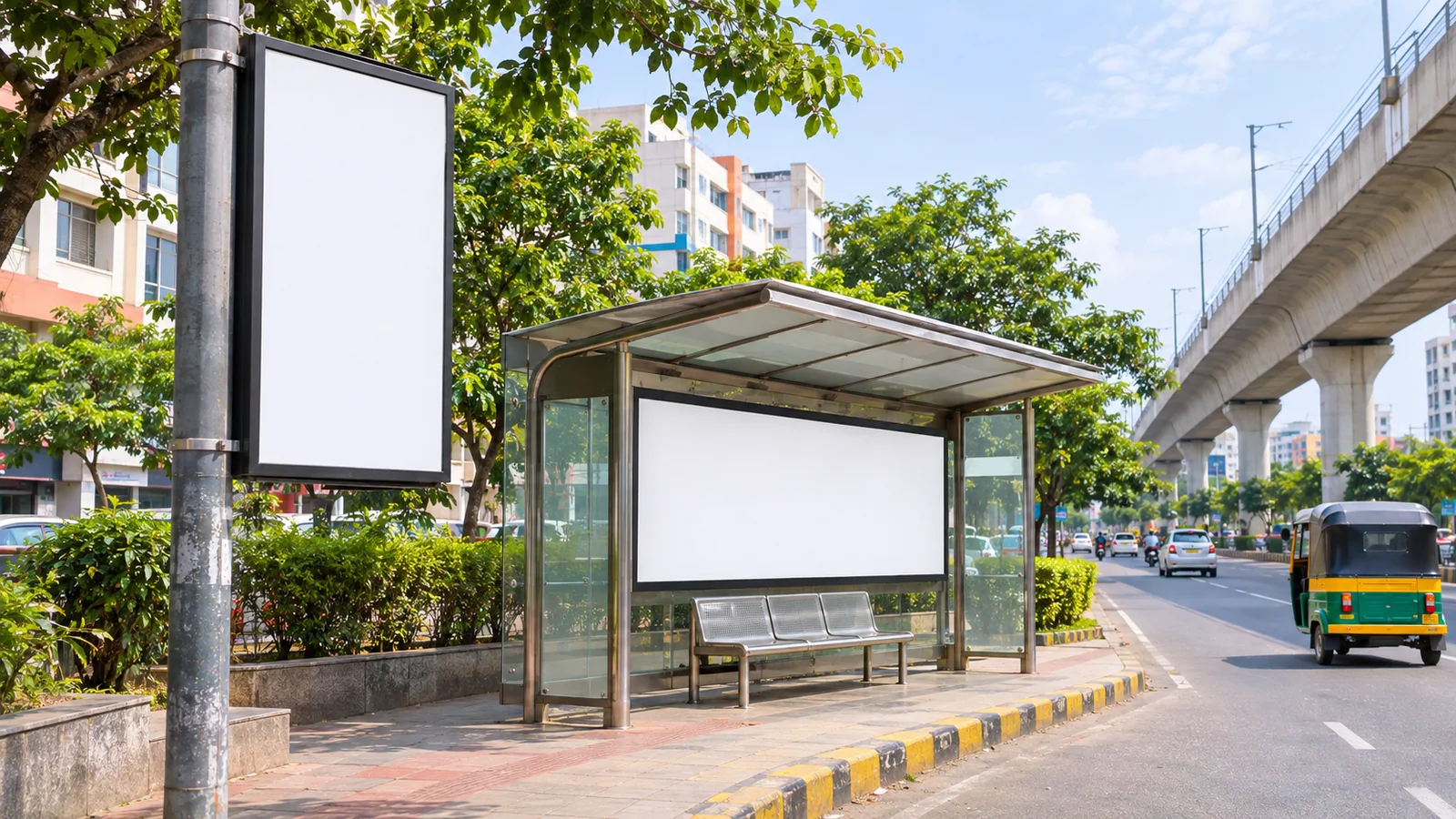
Bus shelters and similar street furniture work for people waiting at fixed stops. Their job is a longer look, which suits a short line plus a clear way to ask for a call back. Whether a given shelter can be used depends on the local body and the contract holder, which AdChowk confirms when it prepares a plan.

Hoardings and unipoles are the large formats on main roads and junctions. Their job is a broad statement of who the institute is, read at speed by people in vehicles. They need the most lead time for permission, and the copy must be short enough to read in a few seconds.

Auto and tricycle branding moves through the neighbourhoods where parents and students already travel. Its job is repetition across many small streets that a fixed board would never cover. It suits awareness messages best, and it is a poor place for fine print, so claims that need disclaimers should stay off it.

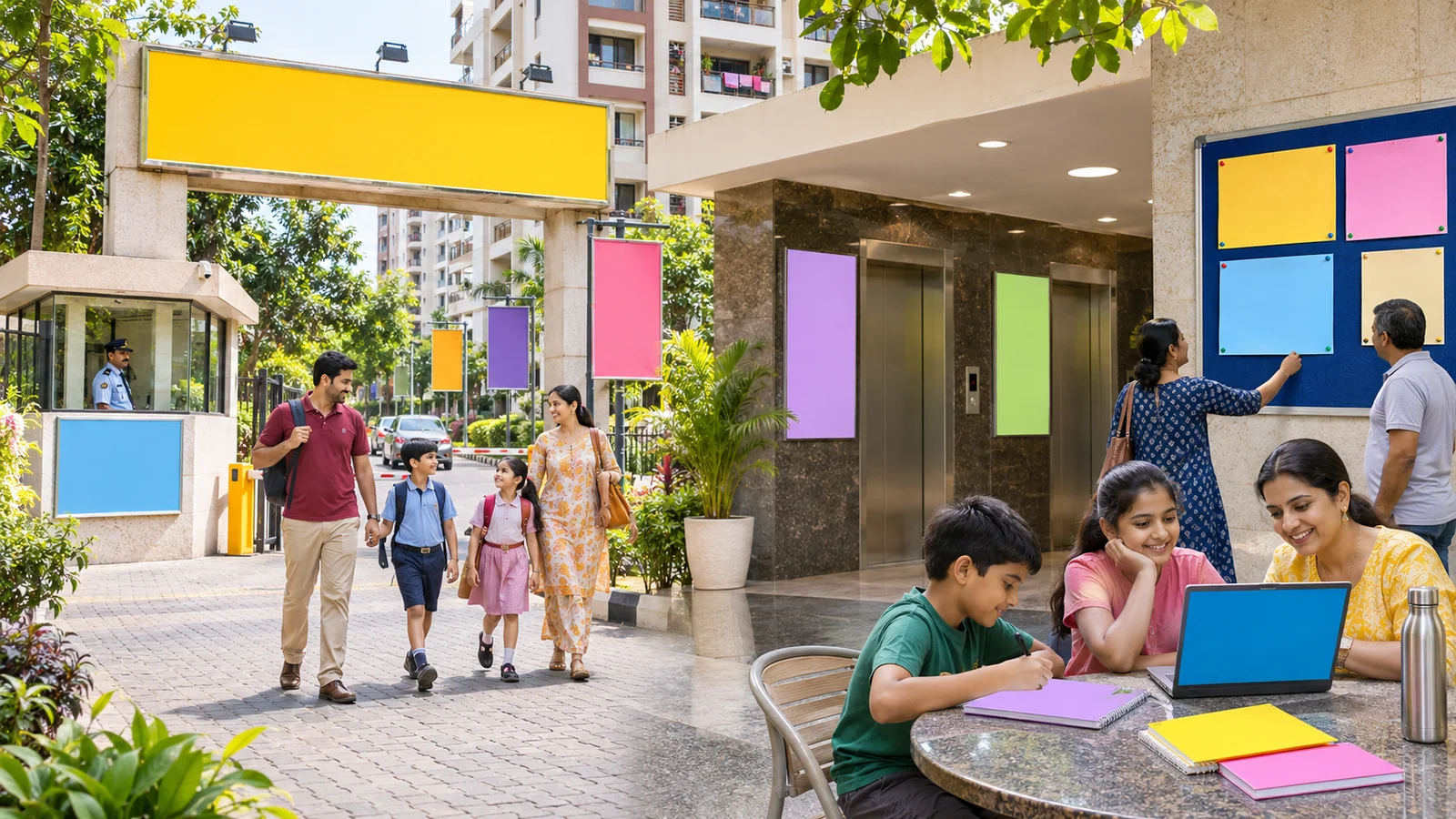
Apartment lift screens and notice-style placements reach families inside gated communities. Their job is a repeated, close-range message to parents, which suits admission-season reminders. They depend on the apartment association agreeing, and some associations will say no.

A good plan uses two or three formats together and gives each one a single job. For example, a fixed board can hold the name in a locality while vehicle branding carries it across neighbourhoods. Using every format at once spreads a small plan too thin to be noticed.

Format availability varies by locality, by the property owner and by the local body. AdChowk's catalogue lists many formats, but not every one can be booked in every locality today. Which formats are actually available near your target families is confirmed when the plan is prepared.

Good ideas. Clear thinking.

Timing: what to do in November 2026 and the windows ahead

A Kukatpally junior college should plan for a window and not a date. In 2026 the Telangana board issued an admission schedule in early May and revised it (reported). The planning judgment is brand-only creative until the board announces its schedule.

For junior colleges, the honest answer on timing is to plan for a window, not a date. In 2026 the Telangana board issued an admission schedule in early May and then revised it, with phases running into August (reported). The 2027-28 reopening is reported as 31 May 2027 for Telangana junior colleges, and the admissions window before it depends on the board's schedule.

AdChowkA little room to read

Timing: what to do in November 2026 and the windows ahead

Continue the story. Keep your place.

Until the board announces that schedule, outdoor creative should be brand-only and should not advertise admissions in the intermediate courses. The planning judgment is to prepare approvals and creative now and to place the main wave after the schedule is out, usually April to June. In Andhra Pradesh, the 2026 pattern was application forms from 1 April and phases to 31 July (reported).

Today is November 2026, which is the build phase and not the peak for the 2027-28 admission year. The build work is to hold sites, start permission paperwork, send creative for a compliance read, and set up tracking numbers and QR codes. Good sites near campuses and coaching routes tend to be taken first in the busy months, which is a planning judgment and not a measured fact.

Lead time matters as much as the window itself. Property-owner consent, municipal checks and creative review each take time, and none of them can be rushed in the week a campaign is meant to start. A sensible rule of thumb, which is a planning judgment, is to begin these steps well before the window opens.

Every window in this article is a planning judgment drawn from the 2026 cycle. Almost every 2027 date is unannounced, and the dates that are reported, such as CBSE board exams starting 16 February 2027, come from news reports and not from the boards' own pages. A date should be checked on the official site before it is printed on anything.

Dates to re-check every month are the NTA exam calendar, the Telangana and Andhra Pradesh board timetables, EAPCET notifications from January and DOST or OAMDC notifications from March. Plans that depend on a window should be written to move when the notice moves. AdChowk's advice is to plan for a window, not a date, and to keep some booking flexibility.

Good ideas. Clear thinking.

What may and may not be printed, and what permission means in Kukatpally

Hoardings, pamphlets and wall writings were reported in 2023 to need prior committee approval. Rank-based outdoor needs the board's clearance and the college's proof. AdChowk cannot grant that clearance and does not describe any board status.

In Hyderabad, news reports describe a municipal drive in January 2026 that removed unauthorised hoardings, banners and flex. Reports also mention a height limit and a new advertisement policy, but AdChowk has not confirmed that the policy is in force. Permission for each site should be checked with the municipal body against its notified text before anything is installed.

AdChowkA little room to read

What may and may not be printed, and what permission means in Kukatpally

Continue the story. Keep your place.

Hyderabad's CURE-2026 policy is reported to restrict advertisements near schools and on hospitals. For that reason AdChowk's education plans go to colonies, lift screens, bus shelters and the routes parents use, and not to school gates or hospital buildings. This is a reported policy, and the notified text should be read before a site near a school or hospital is considered.

Junior college advertising in Telangana sits under the state intermediate board, and the rules below are reported from news, not read from a board notice. A May 2023 report says advertising of intermediate courses was barred until the board announced its admission schedule. The same report says hoardings, pamphlets and wall writings needed prior approval from a committee.

Reports also say rank-based advertisements must carry the college code and the rank category, and that penalties scale with the cost of the advertisement. AdChowk has not seen the current board order, so a college should obtain the present text from the board before printing any rank content. AdChowk's plan for a junior college therefore separates board-cleared rank content from plain brand creative that makes no claim.

In Andhra Pradesh, a 2020 report says publicising intermediate marks and district or state ranks was banned. A 2026 report on the intermediate board's calendar guidance says colleges should not make unverified result claims. The current order should be checked before any marks or ranks appear in outdoor creative in either state.

Across all institute types, the ASCI guidelines of 9 March 2023 ask that statistics refer to the latest completed year and that ranking claims name the publisher and the date. Infrastructure pictures should be real pictures of the institute. Topper testimonials should come only from students who completed the programme with that institute.

A simple test helps before printing any line: can the institute prove it today, with a document, for the year it names? If it cannot, the line should be dropped or turned into plain brand language. AdChowk does not write claims for a client and does not check them in law, so a client's own adviser should read the final creative.

No-parking boards are branded boards on gates and walls, and the property owner's permission is required for each one. AdChowk makes no statement that any format is permitted or cleared, because permission is a separate matter for each site and each local body. A client should treat owner consent in writing as the minimum for any wall or gate.

Good ideas. Clear thinking.

An illustrative plan for Kukatpally, and how AdChowk works

An illustrative plan for a Kukatpally junior college might use colony boards and lift screens near its catchment. A bus shelter and pole boards could be added once the board's schedule is out. No rank, mark or result appears unless the board has cleared it.

The plan above is illustrative only, with no prices, no results and no promised reach. It shows the shape of a plan, and a real plan depends on the institute, its catchment and the sites available. Every number of boards, every locality and every month is to be set after a conversation.


AdChowkA little room to read

An illustrative plan for Kukatpally, and how AdChowk works

Continue the story. Keep your place.

Step one is to state the goal, such as awareness of a new batch, a school open day or a college admission window. Step two is to pick two or three formats near the families the institute serves and give each a single job. Step three is to set up tracking, so that a phone number, QR code or WhatsApp keyword shows which placement prompted an enquiry.

Step four is a compliance read of the creative against the rules above, with every claim checked against a document. Step five is placement in the right window, with permissions in hand before anything goes up. Step six is a review after the first cycle, so that sites which brought enquiries are kept and the rest are dropped.

AdChowk is an outdoor advertising marketplace operated by Shivix Adsphere Pvt Ltd. A client states a goal and a budget, AdChowk plans the mix of formats and localities, and it shows the reasoning behind that mix. Media owners list their sites and keep their own rates, and AdChowk is not an advertising agency.

AdChowk aims to return a GPS-stamped photograph of every placement, so a client can see where an advertisement went up. This is the intended practice and AdChowk will not describe it as a guarantee of results. A photograph shows a placement exists, and it does not show how many people read it.

Question: Is Kukatpally a good place for junior college ads? That is a planning judgment, and a college should check it against where its own students live.

Question: When may a Telangana junior college advertise admissions? Reports say after the board announces its schedule, so the college should check the board's notice.

Question: Can AdChowk promise how many admissions a campaign will bring? No, because outdoor advertising cannot honestly promise admissions, and AdChowk does not state reach or results.

Question: Does this article give prices? No, because AdChowk does not publish prices on this page and quotes only after a conversation about formats, localities and period.

The next step is simple: get a quote for this locality, and AdChowk will respond with a plan for your institute and your locality. AdChowk does not publish a phone number on this page, so please use the form on the page to reach the team. Related reading and tools: education advertising hub; area calculator; admission season calendar; Hyderabad education advertising guide.

Good ideas. Clear thinking.
Ready to plan?

Turn the guide into a real media shortlist

Browse verified inventory by location and format, or ask our team to help build your campaign plan.

Cookie Icon