This guide explains mobile van advertising for an institute: what it is, who sees it, how it is priced and how to plan routes and days. It gives no prices and no reach figures, because AdChowk has not published a client price list and has no measured reach data. Today is November 2026, so the plan is for the 2027-28 intake, and every window is a planning judgment.
What a mobile van is and who sees it
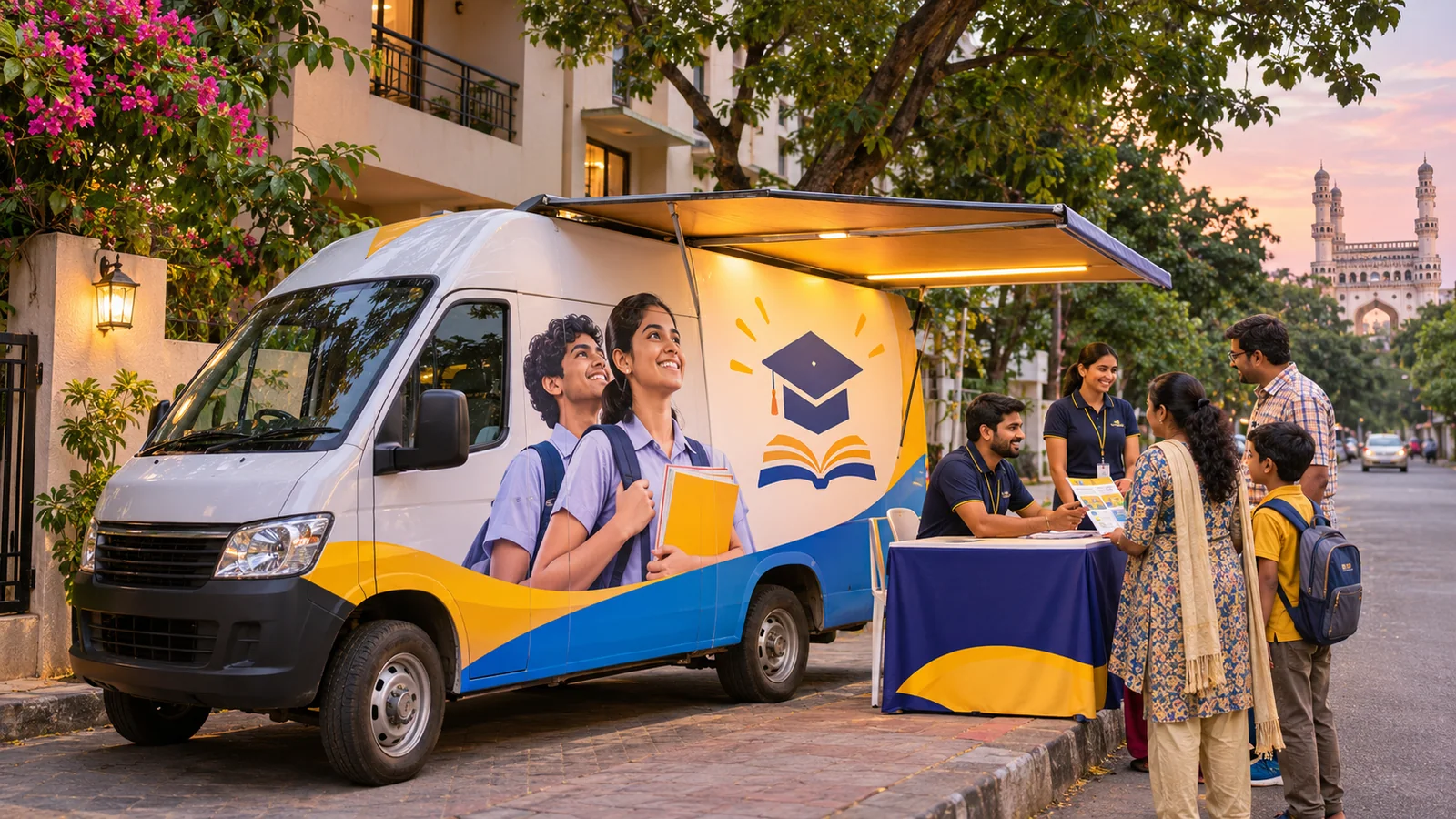
A mobile van is a vehicle branded with an institute's message that drives a planned route, and it may also stop at set points. AdChowk's blueprint for education pages lists mobile vans among the formats it places, and whether a van is bookable on a given date is confirmed at the quote stage. The people who see a van are the ones along its route and at its stops: families in colonies, students near hostels and parents on school routes.
AdChowk has no measured figure for how many people that is, so the guide offers none. Outdoor advertising can honestly take a name into pockets that fixed boards do not reach, and a van does this on a route you choose.
Pricing unit, minimum order and how to size a plan
A van is usually quoted per day or per route, and AdChowk asks for the unit and the minimum on every quote. AdChowk has not published a rate, and it asks that you do not use a figure from another institute's quote. The line in your budget is the number of van-days times the rate per van-day, plus branding, driver arrangements, permission and monitoring.
Branding is the cost of panels or wraps for the vehicle, and it may be a one-time cost spread over the days booked. Driver and route arrangements may be included in the day rate or charged separately, so ask which.
Routes, days, timing and a sample brief
Choose routes by who lives and travels there, and start from the residential pockets that your intake draws from. For a school, that means colonies near the campus and the roads parents use at pick-up time. For a coaching centre, that means hostel areas, residential pockets and the roads to the coaching hub.
For a college, that means areas near junior colleges and the transit routes to the campus. Hyderabad's CURE-2026 policy is reported to restrict advertisements near schools and hospitals, so plan routes that serve families without parking at the gate.
What a van may and may not carry, and the permission note
A van has a large surface, which tempts advertisers to add more claims, and the rules apply whatever the size. Keep the branding to a name, a line and a way to respond, and put detail in the conversation at the stop. Anything said at a staffed stop is also advertising, so brief your staff not to promise selection, rank, jobs or admission.
Permission for a van covers the owner's consent and any rules for stops, and AdChowk does not state that any route or stop is legal or approved. Start with the rule that sits above every format: an outdoor board is an advertisement, and the same education advertising standards apply to it as to any other medium.
An illustrative plan and how AdChowk works
An illustrative plan shows a van campaign, with no prices and no promised results. Imagine a coaching centre in Kukatpally that launches a long-term batch after the results season. It briefs the planner with the sample above and asks for the minimum booking and the unit in writing.
It sends the van design for a compliance read and prepares a staff script that makes no promise of selection. The planner proposes van-days for routes through hostel areas, with the period and a dated quote.