Penalties for Misleading Education Ads: What Has Actually Happened
A sourced list of the penalty actions reported on misleading education ads, which items are secondary, and what AdChowk could not confirm.
AdChowk Editorial Team10 min read
Updated
Plan smarter. Be seen better.
This guide lists the penalty actions on misleading education advertisements that have been reported, and what AdChowk could not confirm. Most items are news or secondary reports, and none is a primary order that we read. It is general information and not legal advice.
Good ideas.
Real places.
What has been reported
The first reported item is a Central Consumer Protection Authority, shortened to CCPA, action against coaching centres. As reported by a secondary source, penalties of about 77.60 lakh rupees were imposed on 24 coaching centres. We did not find or read the CCPA orders, so we cannot confirm the amount, the number of centres or the reasons.
We therefore mark that item as reported and secondary, and we do not repeat it as fact. The guidelines behind such actions are the CCPA coaching guidelines, notified on 13 November 2024, which we read in full at https://livelaw.in/pdf_upload/guidelines-for-prevention-of-misleading-advertisement-in-coaching-sector-2024-571711.pdf. They prohibit false claims about courses, faculty, fees, refunds, selections and ranks, and they prohibit guaranteeing selection, a job or admission.
Small spaces.
Big possibilities.
A plain-English do and don't table
The table below turns the reported actions into plain do and don't lines. It is general information and not legal advice.
| Situation | Do | Do not | |---|---|---| | Results and selections | Keep proof for each figure and state the year | Print a number you cannot prove | | Guarantees | Describe what the course offers | Guarantee selection, a job or admission (CCPA) | | Urgency | Use only real deadlines | Use false urgency or scarcity (CCPA, ASCI) | | Reported penalty figures | Treat them as secondary and unverified | Quote the 77.60 lakh rupee figure as fact | | Sealing of a school | Treat the cause as unconfirmed | Link it to advertising on our word | | Rules by state | Check the board's current notice | Assume a 2023 report is current |
Plan it.
Make it count.
What outdoor can honestly do, and the job each format does
Outdoor advertising can make the name of a coaching centre familiar to students and parents choosing a batch before they start looking. It cannot enrol anyone, and it cannot stand in for a visit, a counsellor or a conversation. Because students and parents choosing a batch usually decide through demo classes, past results and word of mouth, a board is a reminder and not a verdict.
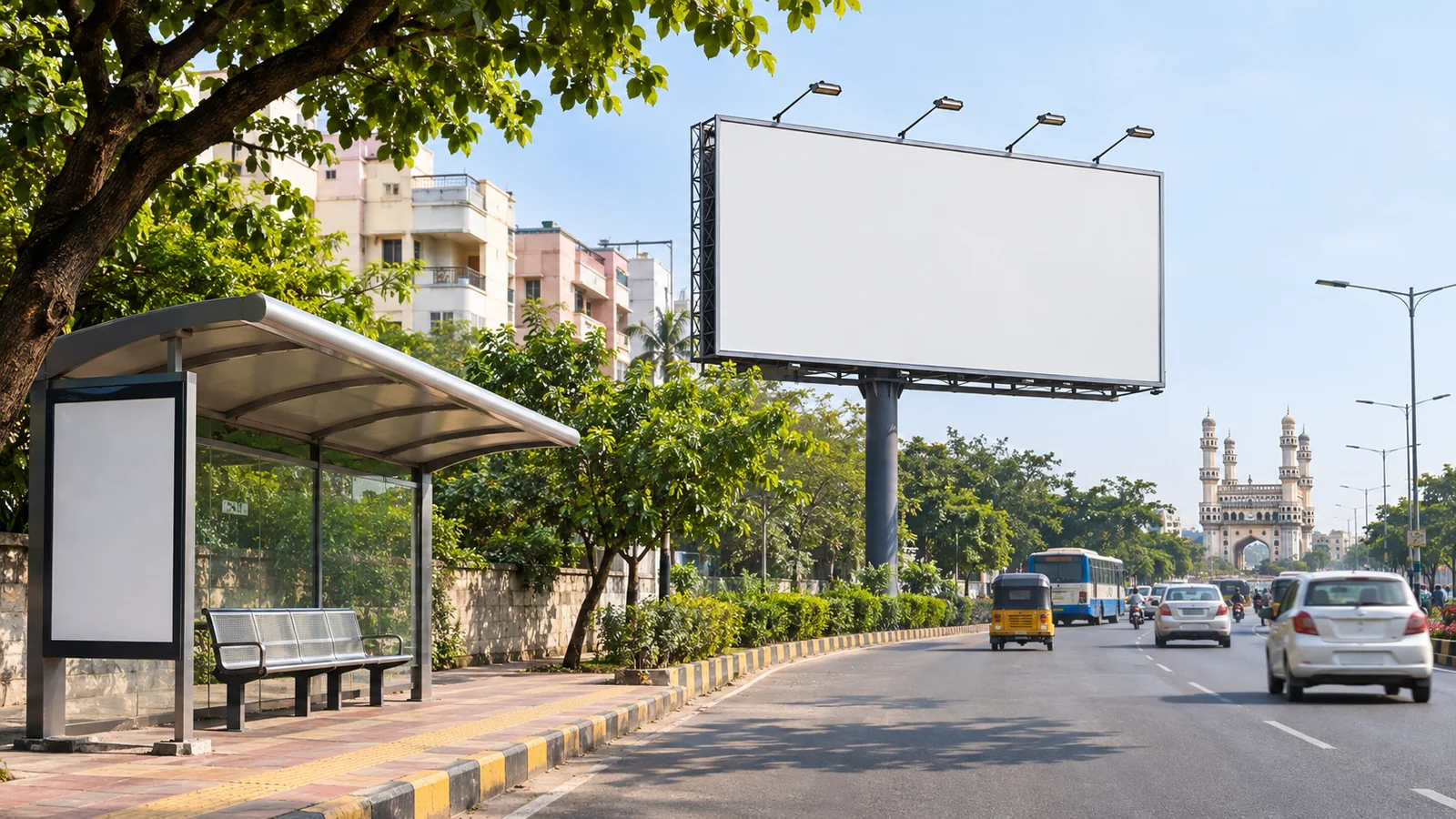
What it can honestly do is repeat one plain message in the places where students and parents choosing a batch already walk, wait and travel. That message should be short: the name, one fact that can be proved, and one way to get in touch. Large formats such as hoardings and unipoles do the job of recognition, because people on the same route see them from a distance every day.
Good ideas.
Real places.
Timing and what may be printed
Today is November 2026, so this is the build phase and not the peak. For a coaching centre, the heavy outdoor window is a planning judgment: March to June, tied to results and the centre's own batch start dates. Almost every 2027 date is unannounced, and the dates we do have come from news reports and not from the agencies themselves.
We use three labels: read in full means we read the text itself, reported means it comes from news, and planning judgment means our own inference. What may be printed is limited to what a coaching centre can prove on paper on the day of printing: the centre name, the course and batch in plain words, true faculty details and one contact line. What should stay off the board is this: guaranteed selection or rank, topper photographs without written consent, or "last seats" wording without evidence.
Small spaces.
Big possibilities.
An illustrative plan and how AdChowk works
Here is an illustrative plan for a coaching centre, written to show the shape of the work and not to promise any result. It contains no prices, because the right mix depends on the budget and the goal you give us. Step one, now in November 2026, is to settle the facts: approvals, names, numbers and photographs the creative may use.
Step two is to send the draft creative for a compliance read and to fix what the read finds. Step three is to shortlist localities around the places students and parents choosing a batch actually use, and to hold sites early for the main window. Step four is a small awareness phase with a few formats, so the message is tested before the main push.
Ready to plan?
Turn the guide into a real media shortlist
Browse verified inventory by location and format, or ask our team to help build your campaign plan.