Trending Now :
37 ad categories. 423 formats. Know more
Hyderabad live — 2,281 sites mapped, 1,810 bookable today. Know more
Every placement photographed on site. Know more

Search for something...
37 ad categories. 423 formats.Browse Now
Hyderabad live — 2,281 sites mapped, 1,810 bookable today.Browse Now
Every placement photographed on site.Browse Now

Flex Banner vs Printed Vinyl Hoarding for Admissions

A neutral comparison of flex banners and printed vinyl hoardings for admissions, with a table, a note on permissions and what may be printed.

Updated

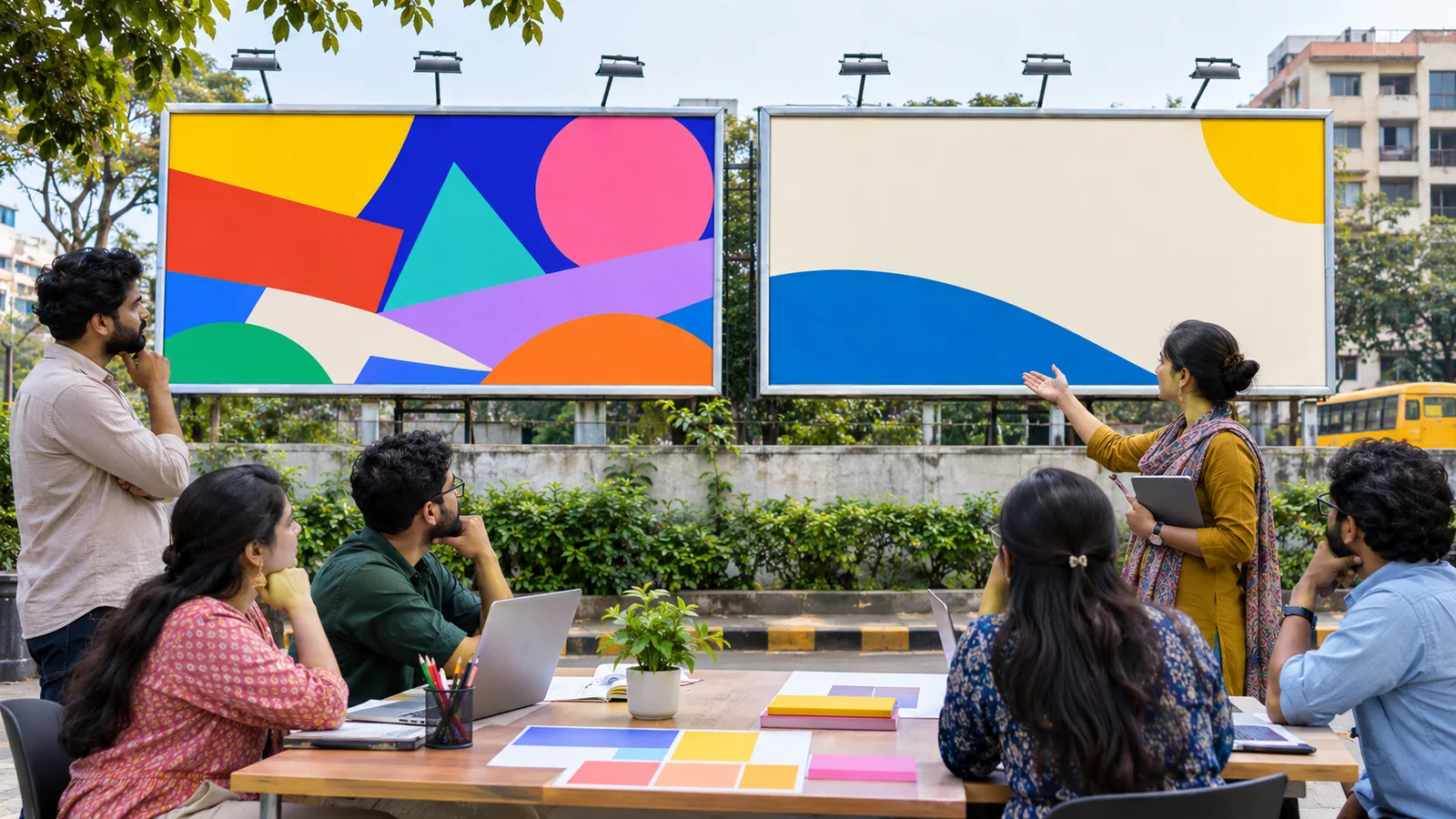
Build a readable hierarchy and an accessible response path editorial illustrationPlan smarter.
Be seen better.

A flex banner and a printed vinyl hoarding do different jobs in an admission season. This guide compares them neutrally, with a table, a note on reported removal drives and what to ask a vendor. It also covers what may and may not be printed.

Two formats, two jobs, and the permission question

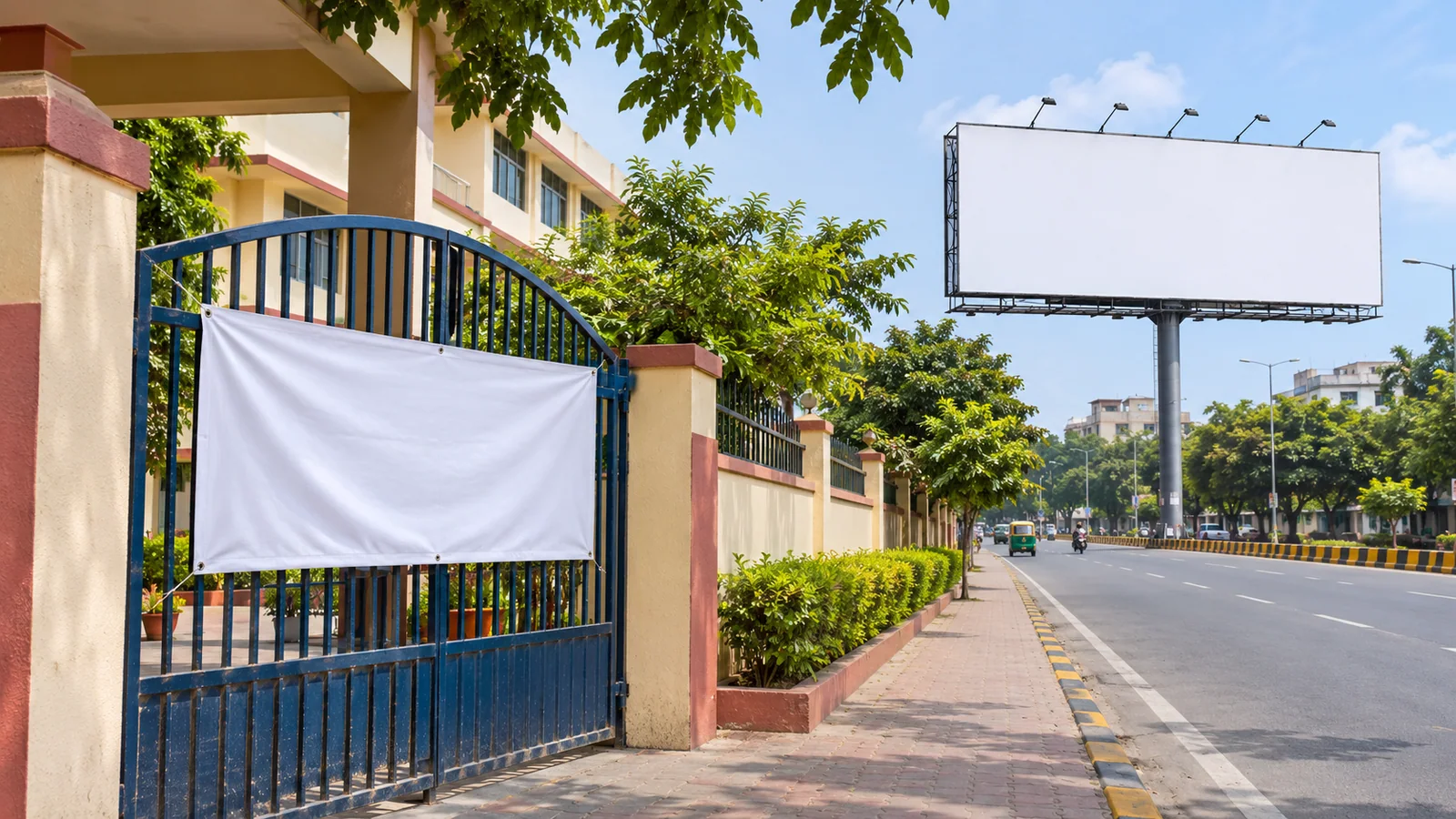
Flex banner or printed vinyl hoarding is a common question when an admission board is being planned. Both are printed sheets stretched on a frame. This guide compares them in neutral terms and says when each tends to fit.

A note on scope first. AdChowk is an outdoor advertising marketplace operated by Shivix Adsphere Pvt Ltd. We carry no prices and no durability figures here because our research has none to give.

AdChowkA little room to read

Two formats, two jobs, and the permission question

Continue the story. Keep your place.

Terms vary by vendor. Here a flex banner means a lighter printed sheet used for short-term or small displays, such as at an event. A printed vinyl hoarding means a larger, planned display on a fixed frame at a site booked for a period.

These are working definitions, not technical standards. Ask your vendor what they mean by each term and what material is used. Get the answer in writing.

Each does a different job in an admission campaign. A flex banner is a quick, local, short-term message such as an open-house date. A vinyl hoarding is a planned, longer-running name-recall display.

Neither can promise admissions. Neither can be promised to bring enquiries in a given number. Any vendor that says otherwise should be asked for evidence.

The honest role of any outdoor format is to make people in a locality notice and remember an institute. It works best when the institute is local. It is less suited to carrying long details.

The bigger risk with banners is not the material but the permission. Hyderabad's civic body was reported in January 2026 to have run a drive removing unauthorised hoardings, banners and flex. That is a reported item, and AdChowk has not read the notice.

Reports also mention a height limit and a new advertisement policy. AdChowk's research could not confirm either as in force. Verify the notified text before you plan.

In Andhra Pradesh, display-device rules were reported as issued in December 2025. The reports mention permission, licensed displayers, insurance and numbering. Check the notified text for your city.

So the first question for either option is who holds the permission. An unpermitted banner can be removed and the cost lost. Ask the vendor to show the permission.

The second question is the site. Is it a property you have the owner's consent for, or a public site? Different rules apply.

The third question is the duration. A short event suits a banner. A season suits a planned display.

The fourth question is the proof. AdChowk aims to return a GPS-stamped photograph of every placement. Ask any vendor how proof is given.

Read this guide with the cost guide. Link: education advertising cost in India. It explains how to ask for quotes without made-up numbers.

Schools can read the main planning guide. Link: school admission outdoor advertising guide. Coaching centres and colleges have their own.

Links: coaching centres and college admission campaigns. The comparison applies to all three. The rules on claims differ by segment.

Start from the purpose. Is the message a date or a name? Dates fit banners, names fit hoardings.

Start also from the calendar. A hoarding site is better secured earlier in the season. A banner can be printed closer to the date.

The sections that follow cover the table, when each wins, what may be printed and a plan. Each is short and plain. Skip to the one you need.

Good ideas. Clear thinking.

A neutral comparison table and what to ask a vendor

Here is a neutral comparison of the two. Every entry is a planning judgment, not a measured fact.

| Question | Flex banner | Printed vinyl hoarding | |---|---|---| | Main job | Short, local message | Planned name recall | | Typical use | Event, gate, short window | Booked site for a period | | Detail that fits | A date and a line | A name and a short line | | Permission | Needs checking; reported removal drives | Needs checking; site and civic permissions | | Lead time | Short | Longer | | Proof | Photograph with a GPS stamp | Photograph with a GPS stamp |

AdChowkA little room to read

A neutral comparison table and what to ask a vendor

Continue the story. Keep your place.

The table has no prices because AdChowk has no basis for them here. It has no durability numbers because none were measured. Treat it as a map of jobs, not a ranking.

The banner wins on speed. It can be printed and put up close to a date. It loses on staying power and on the permission risk.

The hoarding wins on planned presence. It sits at a booked site for the period of the campaign. It loses on flexibility, since changing the message costs time.

Tracking works on both. A code, a number or a WhatsApp keyword on each lets an enquiry name the source. See the guide: WhatsApp keyword per board.

A banner for an open house should carry the date and a contact route. A hoarding should carry the name and a short line. Neither needs a long list.

Other outdoor formats do other jobs. A pole board builds familiarity where people wait or walk. A no-parking board is a branded board on a gate or wall near homes and needs the property owner's permission.

An auto or tricycle carries the name through streets. A bus shelter or lift screen reaches people with time to read. Each deserves its own code.

Ask each vendor what it will not claim. The honest answer includes reach, impressions and return. Write the answers down.

Ask what material is used and why. Different materials suit different durations and weather. Ask what the vendor does if a print fades or tears.

Ask who is responsible for permissions. For a booked hoarding site it is usually the displayer and the site owner. For a banner it may be you; ask for it in writing.

Ask who checks the creative. The institute remains responsible for its claims. A second read before print is cheap.

Ask about removal. Who takes the banner down after an event? Who tells you if it is removed early by an authority?

Ask about the print proof. Look at colours and spelling before the full run. A mistake on a large print is costly.

Ask about language. Telugu and English versions may need separate prints. Plan both from the start.

Ask about the frame and fixing. Safety matters in wind and rain. Ask what checks are done.

Keep the comparison on one page for the trustees. Add your own notes. It is a good start for discussion.

Use the funnel guide to read results. Link: enquiry-to-admission funnel. It explains the limits of attribution.

Seasonality affects every format. Enquiries rise when results are out and when schools reopen. Do not credit one format for a season.

A small test can help. Try one banner for an event and one hoarding for the season and track enquiries. Use the result to adjust.

Good ideas. Clear thinking.

When each tends to win and habits that help

When does a flex banner tend to win? When the message is a date, such as an open house or a counselling day. When permission is clear and the window is short.

When does a printed vinyl hoarding tend to win? When the goal is name recall over a season. When the site and permissions are in place.

AdChowkA little room to read

When each tends to win and habits that help

Continue the story. Keep your place.

When do they work together? A hoarding sets the name and a banner announces the date. Each carries the same contact route.

A small institute with a tight catchment often leans on a few banners on premises it controls and a no-parking board or two. A larger one may book a hoarding on a main road. These are planning judgments, not measured results.

A coaching centre with batch dates may use a banner for the date near its hub. It must keep any results claims within the coaching rules. Collect written consent before any topper image.

A junior college must be careful about timing and claims. Telangana's board is reported to bar intermediate advertisements until it announces its schedule. In 2026 that schedule came in early May and was revised.

A degree or engineering college often plans for April to July. That follows the 2026 pattern of DOST, EAPCET and OAMDC. Counselling-specific claims should wait for official dates.

A school may plan boards from February 2027 as a planning judgment. Hyderabad officials were reported in January 2026 as saying admissions should wait until results in April or May. Check the district education officer's position first.

Do not put up a banner without permission. A removed banner is a lost print and may be a fine. Ask the vendor for the permission.

Do not choose a hoarding because it looks grand. Ask whether the site fits your families. A modest board in the right place beats a large one in the wrong place.

Do not trust a reach claim for either. AdChowk's research does not support such figures. Ask for the method.

Beware of comparisons based on cost alone. A low-priced option may be removed or fade. A costly one may carry more than you need.

Check the creative at reading distance. Print a mock-up and look at it from the road. Fix anything that cannot be read.

Use short lines in Telugu and English. Avoid long lists on any print. Put the contact route in large type.

Plan the removal date. A faded banner reflects badly on the institute. Write the date in the plan.

Keep the permission documents with the plan. They are part of the record. They protect you if a question arises.

Review after each season. Which formats brought enquiries you could answer? Which codes were never quoted?

Retire old codes. Start fresh each cycle. Old codes blur the register.

Keep a map with pins. It helps trustees see the plan. It also helps next year's planner.

If in doubt, ask for a conversation. AdChowk will talk through the options and be honest about what it does not cover. We cannot advise on digital advertising.

This is general information. Check the current notice from the relevant authority before printing. Rules change.

Good ideas. Clear thinking.

What may and may not be printed

The advertising rules apply to whatever you print, whichever format you choose. ASCI's Guidelines for Educational Institutions (9 March 2023) were read in full for this research. They bar implied recognition or accreditation without substantiation.

If an affiliating institution is named, its name should appear at no less than half the font size of the institute's name. Ranking claims must name the publisher and the date. Statistics must relate to the latest completed year.

AdChowkA little room to read

What may and may not be printed

Continue the story. Keep your place.

Infrastructure images must be real. Promised ranks, marks or jobs need substantiation and a past-record disclaimer. The word 100 percent should be avoided on abstract matters.

Topper testimonials may come only from students who completed the programme. False urgency and fear of missing out are discouraged. The simplest safe route is to leave such claims off a board.

For coaching, the Guidelines for Prevention of Misleading Advertisements in the Coaching Sector 2024 were also read in full. They were notified on 13 November 2024 under the Consumer Protection Act 2019. They apply to centres with more than 50 students.

They prohibit false claims about courses, faculty, fees, refunds, selections and ranks. They bar any promise of selection, a job or admission. They also prohibit false urgency.

Topper advertisements must show the rank, the course name, its duration and whether the course was paid for. Disclaimers must be in the same font as the claim. Written consent is taken after selection.

Some rules are reported only, and AdChowk has not read the originals. They include CBSE advisories on affiliation wording and Telangana board approval of junior college advertisements. They also include an Andhra Pradesh ban on publicising intermediate marks and ranks, and AICTE and UGC approval notices.

Hyderabad's CURE-2026 policy is reported to restrict advertisements near schools and hospitals. That is a reason to plan boards on parent routes and in colonies rather than at the gate. Verify the notified text before relying on this.

What may be printed? The institute's name, a plain description, a contact route and a code or keyword. Any claim must be one you can substantiate.

What may not be printed? Promised results, invented numbers, false urgency or implied approvals. Do not print any rule or approval you have not checked.

No-parking boards are branded boards fixed on gates and walls. They need the property owner's permission, kept on file. AdChowk does not describe any board as legal or approved.

Keep a signed-off copy of every creative with its date. Have a bilingual reader check Telugu and English text. None of this is legal advice, and rules change, so check the current notice before printing.

Good ideas. Clear thinking.

Timing, an illustrative plan and how AdChowk works

Timing: today is November 2026, and the 2027-28 season is in its build phase. Heavy outdoor windows are planning judgments, not announced dates. School outdoor is likely to peak from February 2027.

Coaching and degree outdoor is likely to run from March to July 2027. None of the 2027 dates is announced. Junior colleges should wait for the board's schedule.

AdChowkA little room to read

Timing, an illustrative plan and how AdChowk works

Continue the story. Keep your place.

Here is an illustrative plan, with no prices or results. It is a shape, not a recommendation. A day school plans a hoarding for the name and a banner for its open house.

In January it confirms the site and the permissions. In February the hoarding goes up and the banner follows a week before the open house. Each carries a keyword and the front desk logs the answers.

How AdChowk works. AdChowk is an outdoor advertising marketplace operated by Shivix Adsphere Pvt Ltd. You state a budget and an admission goal, and we plan a mix of formats and localities.

We show you the reasoning behind the plan. Media owners list on the marketplace and keep their own rates. We are not an agency and we do not promise results.

AdChowk aims to return a GPS-stamped photograph of every placement. That photograph is the proof that a board is where the plan said it would be. Ask us how it works for your boards.

We agree codes, numbers or keywords with you before printing. The institute keeps ownership of its numbers. We share a weekly report layout.

We cover outdoor formats only. We do not give advice on Google or Meta advertising. If you want digital, ask another adviser.

Our creative read is a check against the rules above, not a legal clearance. It catches common errors early. The institute remains responsible for its claims.

To plan outdoor formats and areas for your goal, open the calculator. Link: area calculator. For the wider education offer, see education advertising.

Next step: open the area calculator and see how a plan could look for your institute. Then send us a WhatsApp message with your institute type, area and dates. We will reply with questions before any plan.

Permission first, print second. That order saves money and embarrassment. It is the one habit worth keeping.

Good ideas. Clear thinking.
Build a readable hierarchy and an accessible response path editorial illustration
Ready to plan?

Turn the guide into a real media shortlist

Browse verified inventory by location and format, or ask our team to help build your campaign plan.

Cookie Icon