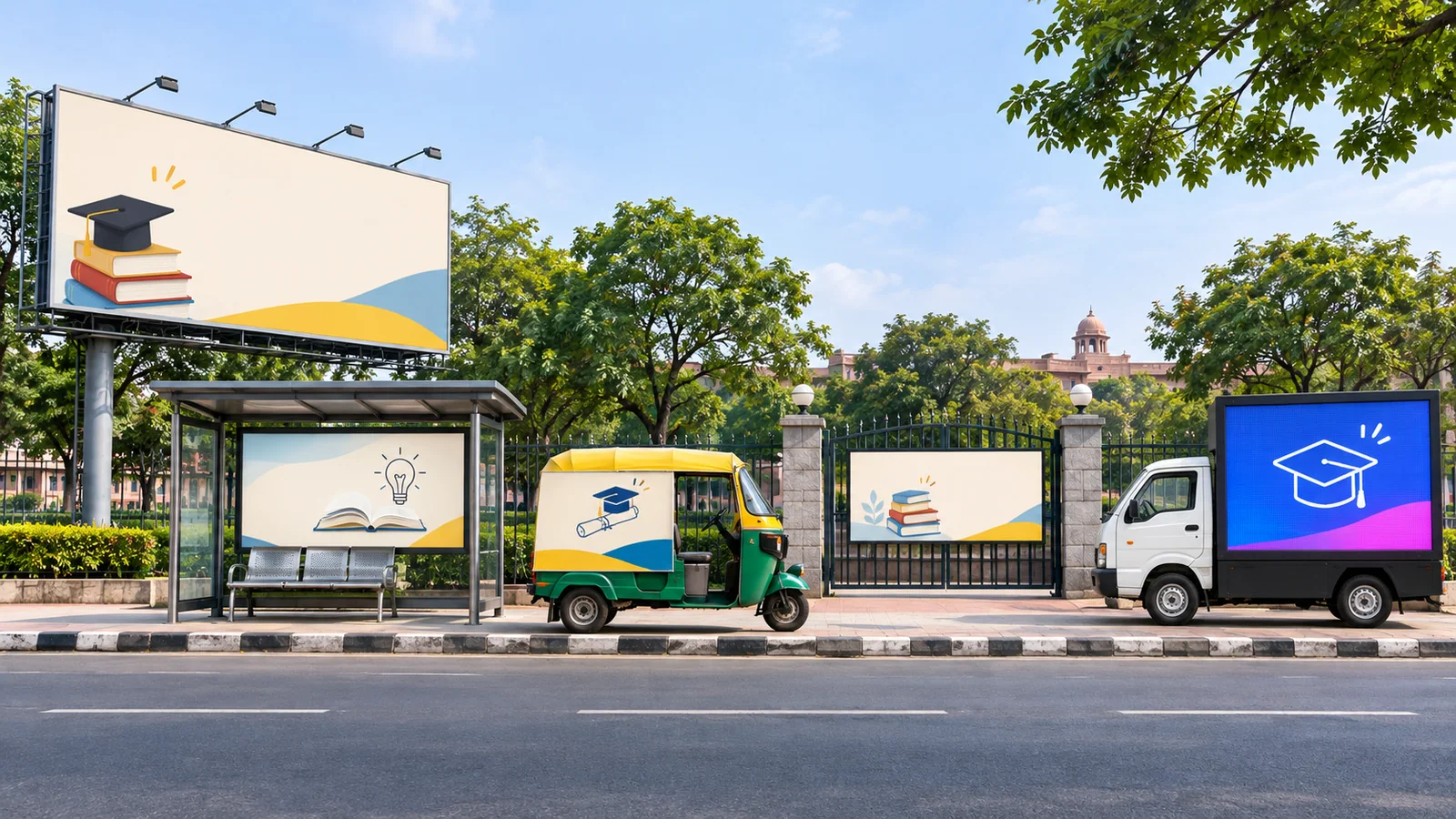
Outdoor formats differ in who sees them, how fast they can change, what proof they leave and how they are priced. This guide compares them on those four things in words, with no prices and no reach numbers, because AdChowk has neither verified. It then gives a plan, a sample brief and the limits.
Reach and flexibility: how outdoor formats differ
Reach means who is likely to see a format, and AdChowk has no measured reach figure for any education campaign, so the comparison below is qualitative. Hoardings and unipoles are seen by moving traffic on a road, so they have a wide and general audience. Bus shelters are seen by people who wait and pass, which suits students and commuters.
Bus back panels and branded buses follow a route, so they are seen along the corridor the bus takes. Auto-tops and tricycle branding travel through lanes and feeder roads, so they reach neighbourhoods that large formats do not.
Price basis, minimum order and proof across formats
Price basis means the unit in which a format is quoted, and AdChowk's research did not settle one unit for every owner, so the list below is a guide to ask about, not a statement of rates. Hoardings and unipoles are commonly quoted per site per period, often per month. Bus shelters are commonly quoted per panel for a period, sometimes in packages by road or zone.
Bus back panels may be quoted per bus for a period, sometimes by route. Auto-tops are commonly quoted per vehicle for a period, and AdChowk saw one vendor listing with a group minimum, which is not a verified general figure.
Timing, permission and what may be printed
Each format has its own permission trail, so a comparison is incomplete without it. Boards on gates need the property owner's permission, and lift screens need the community's, while hoardings and shelters rest on the media owner's permissions. AdChowk does not describe any placement as legal or approved, and its research did not cover every city's rules.
Print only what the rules allow: a name, a short line and one contact step, plus an affiliation line only with substantiation. If you name an affiliating board or university, show that name at no less than half the font size of the institute name.
An illustrative plan and sample briefs
Here is an illustrative plan that uses the comparison to pick formats for a coaching centre and a school; it is a structure and not a quote. Step one is to state the job: name recall in a catchment, a batch announcement, or a trust message. Step two is to match the job to the format that does it best, using the comparison above.
Step three is to rule out any format whose permission, proof or price basis you cannot get in writing. Step four is to choose two or three formats for the first cycle, not all of them.
How AdChowk helps you choose among formats
AdChowk plans a mix of formats and localities against your goal and budget band, and shows the reasoning. You tell AdChowk your institute type, city and area, courses, seats and intake start date, and the planner proposes formats that fit the job. AdChowk's catalogue covers hoardings, unipoles, bus shelters, boards, auto and tricycle branding, lift and mall screens and more, though not every entry is bookable today.
Placements come through media owners listed on AdChowk, who keep their own rates, and AdChowk aims to return a GPS-stamped photograph of each one. AdChowk asks each owner about permissions and does not present any placement as approved by an authority.